
Views: 0 Author: Site Editor Publish Time: 2026-11-02 Origin: Site


The transition from traditional wood-fired saunas to modern electric systems stems from a demand for precision, rapid heating, and automated climate control. Facility managers and homeowners often misunderstand the thermal mechanics and electrical requirements of these units. This leads to under-powered installations, incompatible control systems, or premature component failure. You cannot simply wire a unit to a breaker and expect a perfect microclimate. Proper planning requires a deep look at the physics of heat transfer. Understanding the exact engineering behind an Electric Sauna Heater—from resistive elements to thermal mass dynamics and microclimate management—is the only reliable way to evaluate specifications. By mastering these principles, you calculate power needs accurately and select a unit that ensures long-term operational stability.
Thermal Mechanics: Electric heaters rely on resistive heating elements transferring energy to a specific mass of sauna stones, balancing rapid air convection with sustained radiant heat.
Sizing Dictates Performance: Selecting the correct kilowatt rating (e.g., an 8kW electric sauna heater for a mid-sized room) requires calculating not just cubic volume, but also uninsulated surface areas like glass or stone to ensure rapid heat-up times for spontaneous sessions.
Material Integrity: High-grade materials, specifically a stainless steel electric sauna heater construction, are non-negotiable for preventing corrosion in high-moisture, high-heat environments.
Infrastructure Realities: Installation requires dedicated electrical circuits (often 240V single-phase or 208V three-phase for commercial units) and strict adherence to clearance and ventilation codes.
Buyers need to know how electrical energy converts to a stable microclimate to evaluate different heater designs. A sauna heater operates as a thermodynamic engine designed to balance intense air temperatures with radiant heat and controlled humidity. We see many installations fail because the buyer treated the unit like a standard space heater. Understanding the internal process helps you separate high-performance units from inefficient models that will burn out after a year of heavy use.
The core of any electric heating system relies on resistive elements. Electrical current passes through high-resistance metal alloys to generate intense heat. These elements typically use a nickel-chromium alloy wire suspended inside a protective metal sheath. Manufacturers pack magnesium oxide powder tightly around the wire inside the sheath. This powder acts as an electrical insulator while remaining an excellent thermal conductor. When you turn the system on, the internal wire heats up rapidly. The heat transfers through the powder to the outer sheath, which then heats the surrounding air and stones.
Element surface area and spacing matter immensely in field applications. Tightly packed elements restrict airflow and trap heat. This causes the metal to overheat and burn out prematurely. Well-designed heaters space the elements evenly. This allows air to flow freely between them. Efficient heat transfer extends the lifespan of the elements and ensures the room reaches target temperatures faster. When we inspect failed heaters on job sites, warped and blistered elements are almost always the result of poor spacing or improper stone placement that choked off the airflow.
Sauna stones play a massive role in heat distribution. They absorb direct heat from the glowing elements and release it evenly as radiant heat. Without stones, the heater would just blast harsh, dry air into the room, creating an uncomfortable environment. The stones act as a thermal battery. They store energy and smooth out temperature fluctuations when the thermostat cycles the elements on and off to maintain the set temperature.
You must evaluate the trade-off between low rock capacity and high rock capacity. Heaters with a low rock capacity, usually under 40 pounds, heat the room faster. However, they produce a harsher heat and cool down quickly once the power cuts off. Heaters with a high rock capacity, sometimes exceeding 100 pounds, take longer to warm up. In exchange, they deliver a softer, more sustained heat. Large rock capacities also excel at steam generation. When you pour water over a massive pile of hot stones, it vaporizes instantly into thick, satisfying steam. We always advise clients to carefully place the stones during installation. You never dump them out of the box. You place the largest stones loosely at the bottom between the elements to allow air passage, and pack the smaller stones tighter at the top to catch the water.
Electric heaters rely on a natural convection cycle to warm the room. Cold air enters through an intake vent located near the base of the heater. As this cold air passes over the heated elements and stones, it expands and rises. The hot air travels up to the ceiling, pushes across the room, and slowly cools as it descends along the opposite walls. Finally, it exits through an exhaust vent or recirculates back to the heater.
Heater design directly impacts this airflow. Open-sided heaters feature exposed stones on all sides. This design radiates heat in 360 degrees and creates a milder convection current. Closed-casing heaters force all the air straight up through the top rock tray. This creates a powerful updraft and highly stratified temperatures. The ceiling gets very hot, while the floor remains cool. Your choice of heater style dictates how the heat layers itself inside the room. Proper vent placement is non-negotiable here. We typically cut a 4x6 inch intake vent directly below the heater, about two inches off the floor. The exhaust vent goes on the opposite wall, usually under the top bench, roughly 24 inches from the floor. This forces the hot air to travel down through the room before exiting.
Modern sauna users often want flexibility. Combination electric sauna heaters meet this demand by incorporating integrated water tanks and evaporators. These units do not just heat the air; they actively boil water to inject steady steam into the room. This allows users to actively manage the microclimate without constantly throwing water on the rocks manually.
You can toggle between a traditional high-heat dry sauna and a lower-heat, high-humidity experience. The soft sauna mode usually operates around 140°F with 40% to 50% humidity. It offers a gentler environment for extended sessions. Combi heaters require more maintenance, including regular tank descaling to prevent mineral buildup on the internal boiling elements, but they provide unmatched versatility for diverse user preferences.
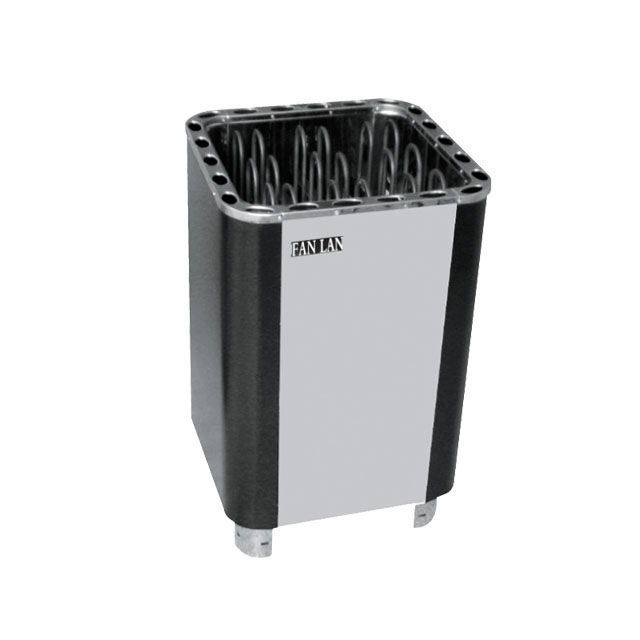
Achieving target temperatures between 160°F and 195°F within 20 to 45 minutes is the primary success criteria for any installation. You want the room hot without overworking the elements. Proper sizing enables spontaneous sauna sessions and protects the equipment from continuous, stressful operation. An undersized heater is the most common mistake we see in residential builds.
The standard industry baseline requires approximately 1kW of power per 45 to 50 cubic feet of well-insulated sauna volume. You calculate the volume by multiplying the room's length, width, and height. For example, a 6x6x7 foot room equals 252 cubic feet. Dividing 252 by 45 gives you 5.6. You would round up to a 6kW heater for this space to ensure adequate power.
Consider the specific use-case for an 8kW electric sauna heater. This size is ideal for standard 350 to 400 cubic foot residential or light-commercial rooms. It provides enough raw power to overcome minor heat losses while bringing the room to temperature quickly. Relying on accurate volume-to-power ratios prevents the frustration of a lukewarm sauna. If you install a 4.5kW heater in a 400 cubic foot room, the elements will run continuously, the high-limit switch will likely trip from the strain, and the room will never break 150°F.
Raw cubic volume only tells half the story. You must account for the uninsulated surface penalty. Materials like glass, bare concrete, heavy stone, and uninsulated tile bleed heat rapidly. For every square foot of these materials, you must add a calculated volume to your base cubic footage. The standard rule adds 1.2 cubic feet for every square foot of glass or stone.
If you ignore these heat loss factors, you risk under-sizing the heater. An under-sized unit runs continuously. The elements never get a break, leading to a shortened lifespan. Furthermore, the room may never reach the target heat on cold days. Conversely, over-sizing the heater causes rapid cycling. The air gets hot quickly, triggering the thermostat to shut off. However, the stones remain cold. When you pour water on them, it pools instead of turning to steam.
Follow these steps to calculate your exact needs:
Measure the interior length, width, height in feet and multiply them to find the base cubic volume.
Measure the square footage of any glass doors, windows, or exposed stone walls.
Multiply that uninsulated square footage by 1.2.
Add the result to your base cubic volume to get the adjusted volume.
Divide the adjusted volume by 45 to find your minimum required kilowatt rating.
| Base Room Volume (Cu. Ft.) | Uninsulated Surfaces (Sq. Ft.) | Adjusted Volume (Cu. Ft.) | Recommended Heater Size (kW) |
|---|---|---|---|
| 150 | 0 | 150 | 4.5 kW |
| 200 | 20 (Glass Door) | 224 | 6.0 kW |
| 300 | 40 (Glass & Stone) | 348 | 8.0 kW |
| 450 | 50 (Large Windows) | 510 | 10.5 kW - 12.0 kW |
Assessing build quality is mandatory to prevent rust, scaling, and structural degradation over a long lifespan. A sauna environment is brutal on metals. Temperatures swing from ambient to nearly 200°F in minutes. Users dump cold water onto scorching hot rocks, creating sudden thermal shocks and high humidity. Only specific materials can survive this abuse without falling apart.
Industry standards dictate the use of 304 or 316-grade stainless steel for outer casings, inner baffles, and rock trays. A stainless steel electric sauna heater resists oxidation because the chromium in the alloy forms a passive protective layer. When water hits the metal, this layer prevents rust from taking hold. We refuse to install anything less on professional jobs.
Compare stainless steel against galvanized or powder-coated alternatives. Galvanized steel relies on a zinc coating. Under extreme heat and continuous exposure to water poured on rocks, the zinc coating degrades and flakes off. Once the raw steel is exposed, rust spreads rapidly. Powder-coated finishes look nice initially but often crack under thermal expansion. Moisture penetrates the cracks, causing the paint to bubble and peel. Stainless steel remains the only reliable choice for longevity in a wet sauna environment.
The materials used to protect the internal heating wires from direct water contact are just as important as the outer casing. Element sheaths face the most extreme conditions. They glow red hot and then receive sudden splashes of cold water. Manufacturers typically use Incoloy or high-grade stainless steel for these sheaths. Incoloy, a superalloy containing nickel, iron, and chromium, offers superior resistance to high-temperature oxidation and thermal shock.
Cheap elements warp, split, or short out when exposed to cold water. When an element splits, water reaches the internal magnesium oxide powder, causing a direct short to ground that will instantly trip your breaker. High-quality sheathing ensures the internal wires stay dry and functional for years, even under heavy daily use.
Navigating the shift from mechanical dials to digital microclimate management changes how you interact with the sauna. Modern control systems offer precise temperature regulation, automated scheduling, and enhanced safety features. Choosing the right control setup depends on your daily routine and installation constraints.
Built-in mechanical controls remain cost-effective and highly reliable. They feature simple timer and thermostat dials located at the base of the heater. However, they require you to bend down and reach under a hot heater to make adjustments. This can be inconvenient in tight spaces, and the mechanical timers eventually wear out from the constant heat exposure.
External digital keypads offer precision and convenience. You mount the keypad on the wall outside the sauna room. This allows you to set exact temperatures before entering. Installing an external controller requires running low-voltage sensor wires from the heater to the keypad location. You must plan for this wiring during the framing stage of construction. We always run a dedicated conduit for the sensor wire to protect it from the high ambient heat inside the wall cavity.
Remote heating facilitates spontaneous use without waiting for the room to warm up. Wi-Fi modules allow you to activate the heater via smartphone apps from anywhere. You can turn the sauna on before leaving the office, ensuring it is at 190°F when you arrive home. This feature has become standard on high-end residential builds.
However, remote operation requires strict safety prerequisites. You cannot simply bypass safety codes. Most jurisdictions require a door sensor to ensure the room is closed and safe before heating begins. If the sauna door is left open, the sensor prevents the heater from turning on. This stops the heater from running endlessly and prevents fire hazards if a towel was accidentally left on the stones.
Every electric heater relies on a high-limit temperature sensor. This sensor mounts on the ceiling directly above the heater. Its function is to prevent thermal runaway and fire hazards. If the ambient ceiling temperature exceeds the safety threshold, usually capped at 194°F, the high-limit switch trips and cuts all power to the elements.
You must manually reset the switch at the heater base once the room cools down. This fail-safe mechanism guarantees the room will never reach combustible temperatures. If your high-limit switch trips frequently, it usually indicates poor rock placement blocking the airflow, or an undersized room for the heater's kilowatt rating.
Differentiating between occasional home use and rigorous facility demands is necessary for a successful build. A heater designed for a basement will fail quickly in a public gym. You must understand the conceptual trade-offs and engineering differences between residential and commercial units to avoid voiding warranties and causing electrical fires.
Residential heaters face strict operational limitations. Safety codes typically restrict them to 60-minute timers. You can turn the dial to activate the heater, but it will automatically shut off after one hour. Some residential controls allow a delayed start, but the active heating cycle remains capped. This prevents homeowners from accidentally leaving the heater on all day.
Commercial facilities need continuous 12 to 24 hour operation capabilities. A gym sauna must stay hot from opening to closing. Commercial controls bypass the 60-minute restriction, relying instead on heavy-duty contactors and constant thermostat monitoring to maintain temperature safely over long shifts. You cannot legally install a commercial controller in a residential home in most jurisdictions.
Structural upgrades define a true commercial unit. A commercial electric sauna heater features heavier-gauge elements designed to withstand non-stop thermal cycling. They boast massive rock capacities, often exceeding 100 pounds, to maintain stable temperatures even when the door opens constantly as members enter and exit.
Furthermore, commercial units utilize external contactor boxes. Standard thermostats cannot handle the massive amperage required to run a 12kW or 15kW heater continuously. The contactor box acts as a heavy-duty relay. The digital keypad sends a low-voltage signal to the contactor, which then safely switches the high-amperage power to the heater elements. We mount these contactor boxes in a dry utility room, never inside the sauna itself.
Power availability dictates heater selection. Standard residential homes utilize 240V single-phase power. Most heaters under 10.5kW operate perfectly on single-phase circuits. However, commercial buildings often utilize 208V or 480V three-phase power.
Three-phase power delivers electricity in three alternating currents, providing smoother, more efficient energy transfer for large loads. You must verify your building's power supply before ordering a commercial heater. Connecting a 240V single-phase heater to a 208V three-phase supply will result in a massive drop in heat output, rendering the sauna unusable. Always have an electrician test the panel voltage before purchasing equipment.
Preventing electrical failures and code violations during deployment requires strict adherence to manufacturer guidelines. Sauna installation is not a basic DIY electrical project. The combination of high amperage, extreme heat, and water demands professional execution. We see countless DIY errors that require complete rewiring.
Standard wall outlets cannot power a traditional sauna. You must hardwire the unit directly to the panel. There are no plug-in models for standard high-heat saunas. The heater requires a dedicated breaker in your electrical panel. Sharing a circuit with another appliance will trip the breaker immediately.
Appropriately gauged copper wiring is mandatory. For example, an 8kW unit typically draws around 33 amps. This requires a dedicated 40-amp breaker and 8 AWG copper wire. Using undersized wire causes the wire itself to heat up, melting the insulation and creating a severe fire risk. Always use copper wire rated for high temperatures, like THHN, and route it through a flexible conduit when passing through the sauna walls. Never use standard Romex inside the hot zone.
| Heater Size (kW) | Voltage / Phase | Amperage Draw | Required Breaker Size | Minimum Wire Gauge (Copper) |
|---|---|---|---|---|
| 4.5 kW | 240V / 1-Phase | 18.8 Amps | 30 Amp | 10 AWG |
| 6.0 kW | 240V / 1-Phase | 25.0 Amps | 30 Amp or 40 Amp | 8 AWG |
| 8.0 kW | 240V / 1-Phase | 33.3 Amps | 40 Amp | 8 AWG |
| 10.5 kW | 240V / 1-Phase | 43.8 Amps | 50 Amp or 60 Amp | 6 AWG |
Strict manufacturer safety clearances to combustible materials must be followed. Every heater manual specifies the minimum distance required between the heater casing and the wooden walls, ceiling, and benches. Ignoring these clearances dries out the wood excessively, lowering its ignition temperature over time through a process called pyrolysis. Eventually, the wood can catch fire at normal operating temperatures.
Ventilation is a mechanical requirement, not an option. You must install an intake vent directly below or behind the heater. This provides fresh oxygen to the convection cycle. An exhaust vent must be placed on the opposite wall, usually under the upper bench or near the ceiling. Proper ventilation ensures proper convection, prevents the heater from tripping its high-limit sensor, and maintains healthy oxygen exchange for the users. A poorly ventilated sauna feels suffocating and takes twice as long to heat up.
To finalize your installation plans, take the following actions:
Calculate the exact adjusted cubic footage of your sauna build, factoring in all glass and stone surfaces to determine the correct kilowatt rating.
Consult a licensed electrician to verify your main panel has the capacity for a new dedicated circuit and confirm your phase power.
Select an electric sauna heater with a stainless steel casing and high-grade Incoloy elements to prevent corrosion.
Map out the exact locations for your intake and exhaust vents before framing the walls to guarantee proper convection airflow.
A: Yes, provided you pour the water directly onto the heated sauna stones and not the exposed metal elements. This generates steam and increases ambient humidity. Pouring water directly on bare elements causes thermal shock and permanent damage.
A: A properly sized unit typically takes 20 to 45 minutes to heat the room to 175°F and fully saturate the stones with heat. This rapid heat-up time makes electric models highly convenient for spontaneous daily use.
A: Consumption depends on the kilowatt rating and duration. An 8kW heater running for one hour uses 8 kWh of electricity. While it draws a high amount of power during operation, the short duration of typical sauna sessions keeps overall energy consumption manageable.
A: Electric heaters warm the air and stones to create a high-heat, convection-based environment capable of producing steam. Infrared saunas use light waves to heat the body directly at lower ambient temperatures with no steam capability.
A: Yes, these are known as hybrid saunas. They utilize infrared panels for quick, direct body heating at lower temperatures, alongside a traditional electric sauna heater to provide high ambient heat and the ability to generate steam.
A: Yes. Almost all traditional electric sauna heaters require a dedicated 240V hardwired circuit installed by a licensed electrician. They draw significant amperage and cannot share a circuit with other appliances without tripping the breaker.
A: For residential use, inspect stones annually and replace them every two to three years. Commercial units require stone replacement every six to twelve months due to continuous thermal expansion and contraction causing the rocks to crumble and block airflow.


