
Views: 0 Author: Site Editor Publish Time: 2026-11-09 Origin: Site

Electrical infrastructure is the most common, yet most frequently underestimated, bottleneck in sauna installation. Purchasing an electric sauna heater without first verifying panel capacity, voltage availability, and wiring routes leads to blown budgets, code violations, or severely underperforming heat times. Many property owners focus heavily on cedar paneling and bench layouts while ignoring the critical power supply required to drive the room to traditional temperatures. This guide details the exact voltage, amperage, and circuitry requirements necessary to evaluate, select, and safely install the correct heater for your space.
Most standard and high-capacity heaters require a dedicated 240V hardwired circuit; 110V plug-and-play models are strictly limited to ultra-compact, single-person spaces.
Power sizing follows a strict baseline ratio: approximately 1 kW of power is required for every 45–50 cubic feet of insulated sauna volume.
Safe installation mandates specific wire gauges (e.g., 8 AWG for an 8kW electric sauna heater) and high-temperature-rated copper wiring near the unit.
Beyond the heater itself, secondary electrical planning is required for sauna accessories (lighting, Wi-Fi modules, and audio), which typically run on separate 110V/120V circuits.
Commercial and residential setups differ significantly in electrical phase requirements, with commercial units often requiring three-phase power and external contactor boxes.
Before selecting any equipment, you must audit your main breaker panel. The panel dictates exactly how much power you can safely draw. Open the panel door and locate the main breaker switch. This switch displays your total service amperage. Older homes often feature 100-amp service. Mid-size homes usually have 150-amp panels. Modern construction typically includes 200-amp service. Adding a dedicated 30-to-50-amp circuit for a sauna heater places a massive load on the system. If you run a central air conditioner, an electric oven, and a clothes dryer simultaneously on a 100-amp panel, adding a sauna will overload the system. Upgrading to a 200-amp panel is frequently necessary for safe operation.
You must also apply the 80% rule for continuous loads. The National Electrical Code (NEC) defines a continuous load as any appliance operating at maximum current for three hours or more. While residential sauna sessions rarely last three hours, the initial heat-up time combined with the session itself pushes the equipment into this category. A continuous load must not exceed 80% of the breaker’s total capacity. If your heater draws 32 amps, you cannot use a 35-amp breaker. You must install a 40-amp breaker to maintain the required safety margin and prevent overheating at the panel.
The following table summarizes standard breaker requirements based on load:
| Heater kW Rating | Required Breaker (Amps) | Minimum Copper Wire Gauge (AWG) |
|---|---|---|
| 3.0 kW – 4.5 kW | 30 Amp | 10 AWG |
| 6.0 kW – 8.0 kW | 40 Amp | 8 AWG |
| 9.0 kW – 10.5 kW | 50 Amp | 6 AWG |
Standard household outlets deliver 110V or 120V power. Heaters designed for this voltage face strict physical limitations. They are typically capped between 1.5 kW and 3.0 kW. You cannot draw more power from a standard wall plug without tripping the breaker. These units are only viable for very small, indoor, highly insulated spaces measuring under 100 cubic feet. They serve primarily as single-person closet conversions or portable tent saunas.
The main trade-off is convenience versus performance. Installation is easier. Some models are entirely plug-and-play. However, they suffer from significantly longer heat-up times. They also struggle to reach the high maximum temperatures expected in a traditional Finnish sauna. If the ambient room temperature drops, a 110V unit may fail to keep up with the heat loss.
For authentic traditional sauna experiences, 240V power is mandatory. This voltage allows the equipment to pull higher wattage, ranging from 4.5 kW up to 10 kW or more for residential units. Doubling the voltage provides the raw energy required to heat dense rocks and large volumes of air quickly.
A 240V system enables rapid heating. It also provides the necessary power to compensate for heat loss. Outdoor saunas face freezing ambient temperatures. Indoor saunas often feature full glass fronts. Both scenarios cause massive thermal loss. Only a 240V system possesses the recovery speed to maintain consistent bathing temperatures under these conditions.
Selecting the correct power output requires basic geometry. Do not guess the required size. Use the baseline calculation formula. Multiply the interior length by the width and the height in feet. This gives you the total cubic volume. Divide that number by 50. The resulting figure equals your minimum required kilowatt (kW) rating.
This baseline formula assumes standard R-13 to R-19 fiberglass or mineral wool insulation in the walls. It also assumes a standard ceiling height of approximately seven feet. Heat rises. Ceilings higher than seven feet trap usable heat above the bathers, requiring more power to push the heat down to the bench level.
Small saunas (under 150 cubic feet) typically require 3.0 kW to 4.5 kW.
Medium saunas (150 to 300 cubic feet) generally need 6.0 kW to 8.0 kW.
Large saunas (over 350 cubic feet) demand 8.0 kW to 12.0 kW.
The standard formula only works for fully insulated wood-paneled rooms. Heavy materials absorb heat rather than reflecting it. You must adjust your calculation for thermal mass. Add 1.2 cubic feet to your total volume calculation for every square foot of uninsulated material.
Common uninsulated surfaces include glass doors, stone accent walls, concrete floors, and exterior windows. A standard glass sauna door measures roughly 20 square feet. Multiply 20 by 1.2 to get 24. You must add 24 cubic feet to your base volume before dividing by 50. Failing to account for glass or stone guarantees a chronically underpowered room.
Consider a backyard barrel sauna or a medium-sized indoor cabin. The physical dimensions measure 6 feet by 7 feet with a 7-foot ceiling. The base volume is 294 cubic feet. The design includes a full glass door and a small window, adding roughly 40 adjusted cubic feet. The total adjusted volume reaches 334 cubic feet. Dividing 334 by 50 yields 6.68 kW.
You always round up to ensure adequate recovery time. This scenario represents the ideal use case for an 8kW electric sauna heater. Powering this specific unit requires robust electrical infrastructure. It usually demands a 40-amp dedicated double-pole breaker. The electrician must pull 8 AWG copper wiring from the main panel to the installation site to handle the load safely.
An electric sauna heater must operate on a dedicated circuit. You cannot share this line with lighting, outlets, or other appliances. The heater draws continuous, heavy amperage. If another device activates on the same line, the combined draw will cause immediate breaker tripping. Bypassing this rule or attempting to splice into existing heavy appliance lines poses a severe fire hazard and violates all building codes.
Standard household Romex wire is rated for normal ambient temperatures. It cannot survive the environment immediately surrounding the heater. The final connection from the wall junction box to the heater terminals requires specialized wiring. You must use 90°C/194°F rated copper wire. Never use aluminum wire for sauna installations. Aluminum expands and contracts differently than copper under extreme heat, leading to loose terminal connections and arcing.
Furthermore, hardwiring is legally mandated for 240V heaters in wet or damp environments. You cannot use standard appliance plugs or heavy-duty dryer receptacles. Hardwiring eliminates the physical plug interface, removing a vulnerable point where moisture could enter and cause a short circuit.
Property owners frequently overlook accessory power during the planning phase. The heater utilizes a 240V circuit. This circuit often consists of two hot legs and a ground, entirely lacking a neutral wire. You cannot tap into this 240V line to power standard accessories.
Interior sauna lighting, Bluetooth audio systems, and external web modules typically require a separate standard 110V/120V circuit. This is usually a basic 15-amp run. Plan for this secondary circuit during the initial trenching or wall-routing phase. Running the 240V conduit and the 110V conduit side-by-side saves significant labor. It prevents the costly mistake of tearing up drywall or re-digging yard trenches twice.
The environment inside a sauna is brutal on metal. Temperatures fluctuate from ambient room levels to over 190°F within an hour. Bathers repeatedly ladle water over the hot rocks to create steam, known as löyly. This sudden introduction of water creates immediate thermal shock and high humidity.
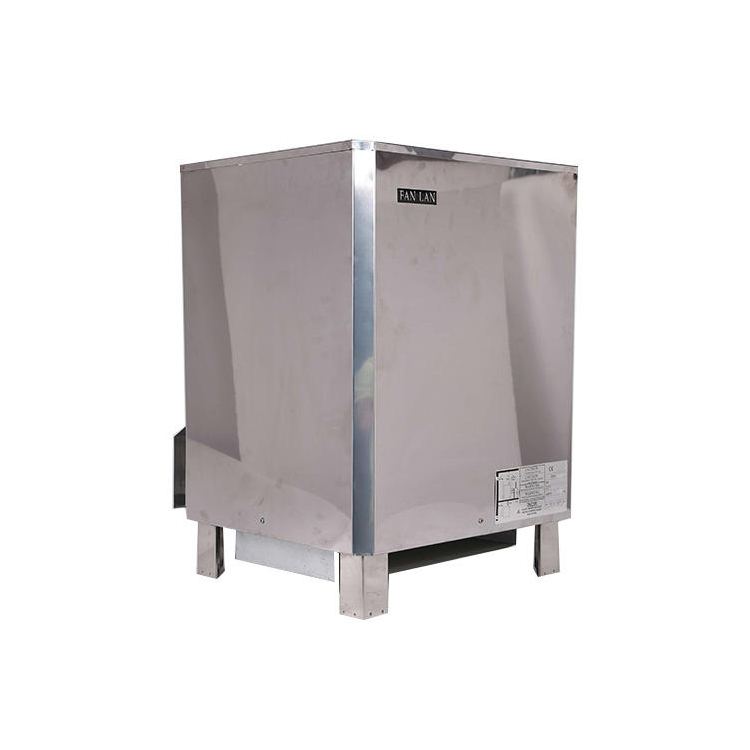
Exterior and interior casing materials matter immensely. Painted steel or cheap alloys will blister, flake, and rust rapidly under these conditions. A stainless steel electric sauna heater resists corrosion from the water ladled over the rocks. The structural integrity of stainless steel also withstands continuous thermal expansion and contraction without warping the outer shell or damaging the internal rock basket.
The resistive heating elements do the actual work. They sit directly beneath the rocks, glowing red hot. Standard elements degrade quickly when exposed to water and extreme heat cycling. High-quality heaters utilize industrial-grade Nichrome or FeCrAl alloys for their elements. These specific compositions are necessary to withstand the extreme temperatures required for effective heat generation. They resist oxidation and maintain their structural rigidity, preventing them from warping, sagging, or snapping under the heavy weight of the sauna stones.
Electrical supply differs fundamentally between homes and public facilities. Standard residential power operates on single-phase 240V. The utility company provides two hot wires to the home. Commercial buildings usually receive three-phase 208V or 240V power, which utilizes three separate hot wires.
A commercial electric sauna heater is specifically wired to accept this three-phase supply. It balances the high-amperage loads across three distinct phases. This distribution reduces the overall strain on the building's electrical grid. Attempting to install a three-phase commercial unit in a single-phase residential home is impossible without expensive phase converters, which are highly impractical for this application.
Usage patterns dictate internal component design. Residential units are legally capped at 60-minute continuous heating cycles. They include a standard 9-hour delay timer. The internal relays are sized for occasional daily use.
Commercial units are built for continuous, all-day operation. They feature 12-hour or even 24-hour duty cycles. The internal components of a standard control pad cannot handle switching 50 amps of power continuously for 14 hours. Therefore, commercial setups require external contactor boxes. The digital keypad sends a low-voltage signal to the heavy-duty contactor box mounted outside the room. The contactor box handles the heavy electrical switching, safely routing the massive power load directly to the heater away from user interaction.
Wiring a sauna is not a weekend project for amateurs. DIY electrical work on high-draw, wet-environment appliances carries severe consequences. Incorrect wire sizing or improper grounding can lead to fatal shocks or structural fires. Furthermore, unpermitted DIY work immediately voids manufacturer warranties. If a fire occurs due to improper installation, your home insurance policy will likely deny the claim.
Hiring a licensed electrician guarantees safety and compliance. A professional ensures that the wire routing from the breaker panel directly to the sauna heater meets all local and national codes. They understand conduit fill capacities, voltage drop over long distances, and proper grounding techniques.
Ground Fault Circuit Interrupters (GFCI) protect people from electric shock in wet areas. However, they create a massive technical conflict in sauna installations. The NEC often mandates GFCI protection for wet locations. Conversely, many sauna heater manufacturers explicitly prohibit GFCI breakers in their installation manuals.
The heating elements naturally absorb microscopic amounts of moisture from the air when not in use. When the heater turns on, this moisture causes a tiny, harmless current leakage to the ground. A highly sensitive GFCI breaker detects this leakage and trips immediately, preventing the heater from operating. This is known as "nuisance tripping." You must navigate this conflict by consulting a local electrical inspector. Often, hardwiring the unit directly to the panel satisfies the safety requirement without needing a GFCI breaker, but local municipal codes always have the final say.
Electrical supply dictates heater choice, not the other way around. Purchasing a heater before auditing your electrical panel is a critical error that leads to delayed projects and wasted money. You must match your room volume, insulation levels, and available amperage to the correct equipment.
Take the following actionable next steps to finalize your project:
Download the manufacturer’s exact electrical specification sheet for your shortlisted heater model.
Map out the physical route from your main breaker panel to the sauna location to estimate wire length.
Consult a licensed electrician for a site evaluation and obtain a comprehensive wiring quote before finalizing the heater purchase.
Secure all necessary local electrical permits prior to beginning trenching or wall modifications.
A: No, you cannot plug a standard sauna heater into a regular wall outlet. Only ultra-small 110V units designed for single-person tent or closet saunas can be plugged in. All standard 240V units require dedicated hardwired connections directly to the electrical panel for safety and code compliance.
A: An 8kW unit typically requires a 40-amp dedicated double-pole breaker. It draws roughly 33.3 amps at 240V. Following the 80% continuous load rule, a 40-amp breaker provides the necessary safety margin to prevent overheating at the panel.
A: Most 240V sauna heaters do not require a neutral wire. They operate using two hot wires and a dedicated ground wire. However, some external digital controllers or specific commercial contactor boxes may require a neutral line. Always verify the specific wiring diagram provided by the manufacturer.
A: Yes, a separate 110V/120V circuit is typically required for interior lights, radios, and Wi-Fi modules. The heater's 240V line cannot power these standard accessories directly. You must run a secondary 15-amp circuit to handle the room's lighting and entertainment needs safely.
A: Wiring costs vary drastically based on specific site conditions. Primary factors include the distance from the main panel to the sauna, whether outdoor trenching is required, and current copper wire market rates. Upgrading an undersized electrical panel will significantly increase the overall installation cost.
A: Breaker tripping is usually caused by an undersized breaker, sharing the circuit with another appliance, or nuisance tripping from an incompatible GFCI breaker. It can also indicate a short circuit in the wiring or a failing heating element. A licensed electrician should diagnose persistent tripping immediately.


