Views: 0 Author: Site Editor Publish Time: 2026-05-13 Origin: Site

Choosing the wrong sauna heater size carries compounding negative effects that ruin the bathing experience. If you install an undersized unit, it runs continuously. This constant strain burns out heating elements prematurely. More importantly, an undersized unit fails to heat the stones sufficiently. Without properly heated stones, you cannot achieve quality steam, known traditionally as löyly. Conversely, installing an oversized unit causes uncomfortable temperature spikes. The system short-cycles, shutting off before the stones ever reach optimal steam-producing temperatures.
Proper sizing is not just about measuring the room. It requires a baseline volume calculation paired with specific penalty multipliers. You must account for real-world heat loss factors like glass, exposed stone, local climate, and ceiling height.
This guide skips the generic estimates. We use industry-standard thermodynamics formulas and electrical reality checks to help you determine the exact kW capacity required for your space. You will learn how to balance physical room dimensions with your home's electrical capabilities.
The Golden Ratio: For standard, well-insulated indoor saunas, calculate 1 kW of power for every 45 cubic feet of volume.
The Glass Penalty: Uninsulated surfaces drain heat. Add 1 cubic foot of volume to your calculation for every 1 square foot of glass or stone.
The Boundary Rule: If your final calculation lands between two heater sizes, always size up. A larger electric sauna heater can be dialed down, but a smaller one cannot exceed its maximum output.
The Bottleneck: Electrical panel capacity (30-amp vs. 40-amp breakers) is often the ultimate deciding factor between a 6kW and an 8kW heater.
Before considering environmental heat loss, you must establish an absolute baseline. This evaluation dimension represents the core heating load of your room. Every calculation starts with determining your interior volume.
We perform this initial math assuming a perfect environment. The base formula relies on your walls and ceiling featuring standard R-11 or R-13 insulation. It also strictly assumes an optimal ceiling height of exactly 7 feet. If your room deviates from these ideal conditions, you will adjust the numbers later in the process.
Follow these steps to find your raw kilowatt requirement:
Measure the interior length of your room in feet.
Measure the interior width of your room in feet.
Measure the interior height of your room in feet.
Multiply these three numbers together (Length × Width × Height). This equals your total cubic footage.
Divide your total cubic footage by 45.
The industry standard dictates that 1 kW of electrical heating power effectively warms 45 cubic feet of well-insulated space. For example, a room measuring 6 feet long, 5 feet wide, and 7 feet tall equals 210 cubic feet. Dividing 210 by 45 gives you 4.66. In a perfectly insulated vacuum, you would need a 4.66 kW sauna heater.
However, perfect environments rarely exist. Raw volume calculations only serve as your starting point. You must mathematically penalize your baseline for structural realities before purchasing equipment.
Implementation realities quickly complicate raw volume calculations. Uninsulated surfaces actively steal heat away from the room. These areas act as thermal sinks. We call them "heat-storing surfaces" because they absorb energy before the surrounding air can properly warm up. You must mathematically adjust your cubic footage to compensate for these structural inefficiencies.
Modern designs frequently incorporate heavy glass elements and exposed masonry. While visually stunning, these materials drastically reduce thermal efficiency. Every 1 square foot of glass, concrete, or heavy log requires adding 1 cubic foot to your base volume calculation.
Consider a standard glass door. Even a small uninsulated window drains heat. Now, imagine a custom build featuring an entire glass front wall.
Example Scenario: You build a room with a 6-foot by 7-foot full-glass front.
The Math: 6 multiplied by 7 equals 42 square feet of glass.
The Adjustment: You must add 42 cubic feet of heating load to your base volume.
This penalty often pushes your required capacity into the next hardware tier. A room calculating perfectly for a 6kW unit might suddenly require an 8kW electric sauna heater simply because you added a glass wall.
Heat naturally stratifies. Hot air rises immediately toward the ceiling, pushing cooler air downward. The traditional and ideal ceiling height is exactly 7 feet. This height perfectly balances spatial comfort with thermal efficiency, keeping the hottest air near the bathers' heads and shoulders.
When you build a ceiling higher than 7 feet, you waste energy heating empty space. For every 1 foot of height above 7 feet, add an additional 0.5 kW to your required heater size.
If you build an 8-foot ceiling, you trap the best heat far above the top bench. Unnecessary headroom forces the heating unit to work harder to push warm air down. Without adjusting your calculation, an 8-foot ceiling leaves the lower benches uncomfortably cold.
Many beginners make a critical error when calculating cold surfaces. They add the floor square footage to their penalty calculations. Do not add your floor area to your cold surface math.
Because heat rises rapidly, floor temperatures remain relatively stable and cool. The floor material has a negligible impact on overall heat loss. Whether you use concrete, tile, or vinyl on the floor, it does not steal significant energy from the heating elements above. Ignore the floor when tallying your heat-storing surfaces.
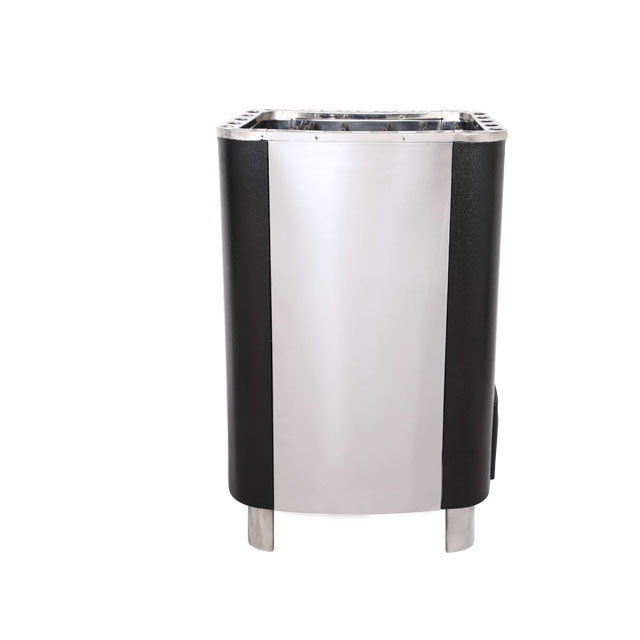
Many buyers land at a frustrating mathematical boundary. Suppose your adjusted calculation equals exactly 265 cubic feet. You sit right on the dividing line between a 6kW and an 8kW unit. This boundary creates the most common sizing dilemma.
Experts generally recommend building a 10% to 15% capacity buffer into your final choice. Sizing up offers several distinct operational advantages:
Faster Heat-Up Times: A larger unit reaches your target temperature in 20 to 30 minutes, rather than struggling for 45 minutes or more.
Better Steam Generation: The stones reach higher core temperatures. When you ladle water over them, they vaporize it instantly and recover their heat faster.
Power Management: You can dial down a larger unit using the digital controller. It will run at lower power to save energy. You cannot force a smaller unit to exceed its hardware limits.
While a slight buffer helps, massive oversizing creates severe performance problems. Exceeding a 15% buffer often leads to rapid short-cycling.
Short-cycling happens when a massive heating element rapidly blasts the small room with hot air. The ambient air temperature quickly hits the thermostat limit. The thermostat dutifully shuts the unit off. However, because the air heated so quickly, the stones never absorbed enough thermal energy. You sit in a hot room, but when you pour water on the cold stones, it just pools and boils away poorly. The steam quality plummets.
Hardware form factor also influences how effectively a unit heats a room. Cylindrical heaters naturally combat the "cold feet" issue better than standard wall-mounted units.
A cylindrical unit stacks stones all the way down to the base. It radiates heat from the floor level upward in 360 degrees. This design creates a more even temperature gradient from floor to ceiling. Because of this structural efficiency, cylindrical units occasionally allow for slightly more room volume per kW compared to traditional box-style wall units.
Use this tiered matching logic to shortlist your equipment. You must base your decision on your adjusted cubic footage. Ensure you add your base volume to your glass and stone penalties before checking this chart.
Adjusted Volume (cu. ft.) | Recommended Power (kW) | Best Use Case & Application |
|---|---|---|
Under 150 | 3.0kW to 4.5kW | Ideal for compact, 1-2 person indoor closet conversions. Minimal glass. |
150 – 270 | 6.0kW | The standard for most indoor home builds. Requires careful glass management to stay in tier. |
270 – 360 | 8.0kW | Best for heavy glass-front designs, outdoor installations, or fast heat-up requirements. |
360 – 600+ | 10.5kW to 15.0kW | Requires commercial-grade wiring, extra-large dedicated breakers, or dual-heater setups. |
This framework simplifies the decision. Always pinpoint your adjusted volume first. If your calculation pushes you close to the upper limit of a tier, refer back to the boundary rule and consider stepping up to the next bracket.
You can calculate thermodynamics perfectly, but your home’s electrical panel dictates your true scalability. Implementation risk often lies entirely inside your basement breaker box. The physical capacity of your main panel serves as the ultimate ceiling for your heating equipment.
Electrical codes require continuous duty appliances to operate safely without overloading circuits. These units draw massive amperage continuously. You must respect electrical infrastructure realities before buying larger equipment to compensate for aesthetic glass walls.
A standard 6kW unit generally presents an easy installation path. It typically requires a 30-amp dedicated double-pole breaker. You must pair this breaker with standard 10 AWG copper wiring.
Most modern residential homes handle a new 30-amp circuit easily. You usually have enough physical slot space and overall service amperage to support this addition without undertaking a costly main panel upgrade. This convenience makes 6kW units the most popular choice for indoor residential builds.
Jumping to an 8kW unit significantly increases the electrical demand. It requires a 40-amp dedicated double-pole breaker. Because it draws higher current, you must step up to thicker 8 AWG copper wiring to prevent overheating inside the walls.
Many older homes lack the extra 40 amps of available capacity. If your panel only has 100-amp total service, adding a 40-amp continuous load might exceed your safe limit when combined with your oven and HVAC system.
Never guess your electrical capacity. Before purchasing a larger unit to compensate for uninsulated surfaces, take immediate action. Have a licensed electrician verify your main panel. They must confirm you possess the physical space and the available amperage capacity to support a continuous 40A or 50A load safely. Solving the electrical bottleneck first prevents frustrating returns and project delays.
Calculate Base and Penalties: Sizing requires establishing your base volume (L×W×H) and actively penalizing for cold surfaces like glass and stone.
Manage Ceiling Heights: Keep ceilings at 7 feet. If you build higher, apply the 0.5 kW penalty for every additional foot.
Choose the Larger Option at Boundaries: When your calculated volume sits exactly on the boundary between two sizes, choose the larger kW rating to guarantee adequate steam.
Verify Your Electrical Panel: Consult a licensed electrician with your target kW rating to confirm installation viability before you finalize any purchases.
Take Action Today: Review detailed hardware specifications on our 6kW and 8kW collections to match a unit perfectly to your adjusted room volume.
A: Yes. Outdoor installations constantly fight ambient environmental cooling, especially in freezing winter climates. Automatically add a 10% to 20% multiplier to your final cubic footage calculation to account for severe environmental heat loss.
A: The room will take well over an hour to heat. The top temperature will plateau uncomfortably low. Furthermore, the internal heating elements will degrade significantly faster due to constant, uninterrupted operation trying to reach an impossible target temperature.
A: Barrel saunas generally lack internal wall insulation because they are single-wall structures. You must size up by at least one full kW tier. In extreme winter regions, experts often recommend using a wood-fired stove instead of electric units to guarantee adequate heat.


