
Views: 0 Author: Site Editor Publish Time: 2026-10-08 Origin: Site

Facility operators and developers are shifting away from utilitarian plastic cold plunge units. They now favor natural materials that match the aesthetics of luxury residential and commercial wellness environments. This transition introduces a specific operational problem. You face inherent friction between the visual appeal of natural wood and the harsh realities of continuous water contact, outdoor weather exposure, and high-frequency use. Addressing this requires a rigorous technical evaluation framework. Buyers must assess structural integrity, cooling technology, smart connectivity, and supplier reliability before committing to wholesale orders. This guide provides actionable field insights for evaluating these components. We will cover material synergy, chiller specifications, and implementation risks when sourcing an ice bath.
Material Synergy is Critical: The longevity of outdoor wooden ice bath tubs depends entirely on the integration between the exterior wood species (e.g., cedar) and the interior liner (stainless steel or acrylic).
Cooling Dictates Throughput: A high-end aesthetic must be backed by commercial-grade chiller specifications and smart connectivity to maintain target temperatures during back-to-back usage.
OEM Vetting Mitigates Risk: Partnering with a verified wooden ice bath OEM manufacturer requires strict evaluation of their quality control processes, electrical certifications, and warranty structures.
Maintenance is Non-Negotiable: Wood requires ongoing treatment; calculating operational expenses must include labor for wood sealing, filtration upkeep, and component servicing.
Defining success criteria for a wooden tub requires looking beyond basic water chilling capabilities. A viable unit must deliver exceptional visual appeal, structural durability, user ergonomics, and consistent temperature control. Commercial facility operators need equipment that withstands daily rigorous use while maintaining a pristine architectural appearance. When developers build luxury wellness retreats or high-end outdoor recovery spaces, dropping a rotomolded plastic tub onto a custom cedar deck breaks the visual flow. Natural wood finishes elevate the prestige of these spaces. They create an inviting, organic atmosphere that standard acrylic or inflatable models simply cannot match. Premium craftsmanship transforms a functional recovery tool into a permanent architectural fixture.
Target demographics for these units span a wide spectrum, dictating how the equipment must perform. Beginners often seek an elegant, approachable entry into wellness routines. They prefer aesthetically pleasing setups that blend seamlessly into high-end home gyms, boutique spas, or landscaped backyards. Conversely, professional athletes and high-volume clinics require rigorous, daily recovery tools. They need deep immersion, rapid cooling capabilities, and heavy-duty filtration. Meeting both demands requires a careful balance of exterior design and internal performance. Outdoor wooden ice bath tubs bridge this gap by housing commercial-grade cooling technology within sophisticated, weather-resistant wooden enclosures.
Retailers and distributors also see significant margin potential with wooden units. The perceived value of crafted wood, especially when paired with high-performance chilling technology, allows for premium market positioning. Buyers are willing to invest in equipment that looks like custom furniture rather than temporary fitness gear. This shift in consumer expectation means that sourcing high-quality wooden units is no longer just an aesthetic choice; it is a strategic operational requirement for capturing the high-end wellness market.
Selecting the right wood species dictates the physical lifespan of the unit. Western Red Cedar (Thuja plicata) remains a top choice for exterior applications. It contains natural tannins and thujaplicin, compounds that provide inherent resistance to rot, decay, and wood-boring insects. Cedar also offers excellent thermal insulation properties, helping to maintain internal water temperatures. Thermowood is another highly stable option. Manufacturers bake ash or pine at temperatures exceeding 400°F. This thermal modification process collapses the cell structure of the wood, preventing it from absorbing moisture later. This makes the wood highly dimensionally stable and resistant to warping under severe outdoor temperature fluctuations. Teak offers marine-grade durability and a dense grain, but it significantly increases the overall weight and shipping footprint of the unit.
Craftsmanship directly impacts structural failure rates. Traditional barrel designs rely on precision joinery. Tongue-and-groove staves must fit perfectly to accommodate natural wood expansion and contraction. Reinforced stainless steel banding prevents the wood from bowing outward under hydrostatic water pressure. Poor joinery leads to structural gaps, allowing moisture to penetrate the core of the wood, which accelerates decay.
Interior liner technologies separate the chilled water from the wood enclosure. Buyers must evaluate different materials based on their intended use case and sanitation requirements.
316L Stainless Steel: Offers the highest durability and clinical sanitation. The "L" denotes low carbon, which makes it superior for TIG welding. Grade 316 resists pitting and corrosion from salt, ozone, and chlorine far better than standard 304 stainless.
Vacuum-Formed Acrylic: Provides a seamless, comfortable interior with rolled edges. Acrylic offers better natural insulation, prevents thermal bridging, and is generally more cost-effective to manufacture in complex ergonomic shapes.
Fiberglass Reinforced Plastic (FRP): Often used as a backing for acrylic to provide structural rigidity against the weight of the water.
Condensation presents a massive hidden risk in wooden plunge units. When 39°F water sits inside a steel tub, and the outside air is 85°F with high humidity, heavy condensation forms on the exterior of the steel liner. If this moisture transfers to the wood cladding, the unit will rot from the inside out. Manufacturers must install closed-cell spray foam insulation to act as a vapor barrier, preventing this thermal bridging. Weatherproofing standards are equally strict for outdoor deployment. Units require marine-grade sealants on all joints and UV-resistant penetrating oils. Elevated base designs or composite skids are necessary to prevent ground-moisture wicking into the bottom of the wooden frame.
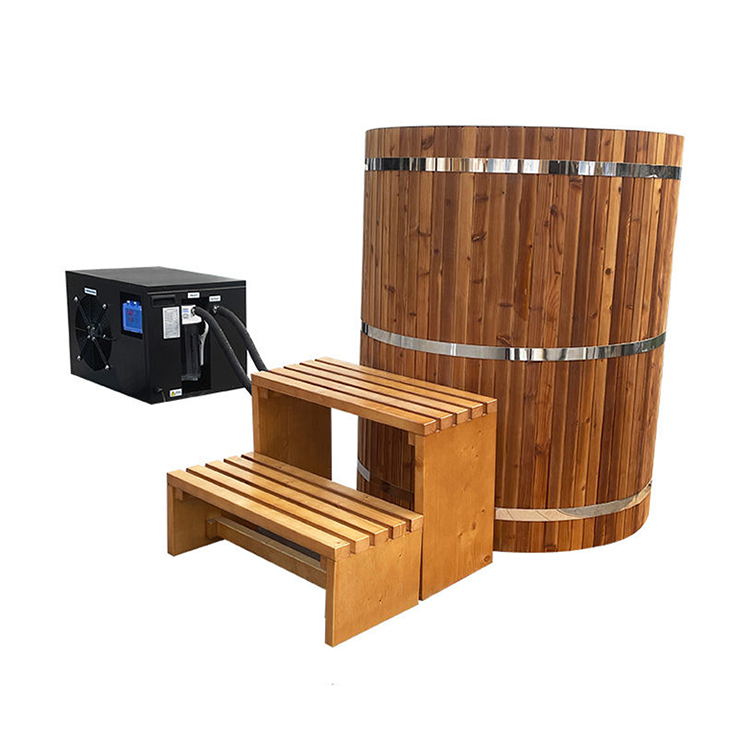
Evaluating a cedar cold plunge barrel with chiller integration requires analyzing the underlying cooling architecture. Split-system units separate the compressor from the tub, placing the noisy mechanical components away from the user to enhance the sensory experience. All-in-one units house the chiller within or directly alongside the wooden enclosure for a smaller, plug-and-play footprint. Cooling capacity dictates operational performance. A standard unit needs at least a 1/2 HP compressor (yielding roughly 5,000 BTU/hr) to drop and hold water temperatures at 37°F–42°F (3°C–5°C). High-ambient outdoor environments or high-volume commercial settings demand robust 1 HP rotary compressors (yielding roughly 10,000 BTU/hr) to maintain these temperatures during continuous, back-to-back use.
Smart cooling and connectivity streamline facility management and reduce manual oversight. Wi-Fi and Bluetooth-enabled chillers allow operators to monitor units remotely via mobile applications. Dedicated apps provide automated scheduling capabilities. Operators can program the chiller to power down overnight to save electricity and pre-chill two hours before the facility opens. Maintenance alerts notify staff of low water flow, pressure drops, or filter blockages. This connectivity prevents unexpected downtime and protects the compressor from burning out due to restricted flow.
Filtration and sanitation protect both the user and the mechanical equipment. Stagnant cold water breeds bacteria, and commercial setups require aggressive water management.
Particulate Filtration: 20-micron pleated paper filters capture skin cells, hair, and environmental debris. These must be easily accessible for weekly swapping.
Ozone (O3) Injection: An ozone generator injects gas into the water line, oxidizing bacteria and breaking down organic matter instantly.
UV-C Sanitation: Water passes through a stainless steel chamber exposed to UV-C light, which disrupts bacterial DNA and prevents replication.
Plumbing architecture must handle freezing ambient temperatures and high internal pressure. Insulated, commercial-grade Schedule 40 PVC or braided stainless steel hosing prevents leaks. Uninsulated pipes suffer from heavy condensation, which drips and damages the surrounding wood base. Units transitioning between indoor and outdoor use require accessible drainage valves, standard garden hose adapters, and proper ventilation grates to ensure the chiller exhaust does not overheat the internal enclosure.
Footprint and water volume dictate the user experience and the installation requirements. Standard upright barrels offer a compact footprint, usually around three feet in diameter. They force users into a seated, vertical posture. This suits small residential patios and beginners who prefer to keep their chest or shoulders above the water line. Horizontal tubs require significantly more floor space but allow for full-body, supine immersion. Tall athletes prefer horizontal configurations to submerge their knees, torso, and neck simultaneously without cramping.
Evaluating a wholesale two person wooden ice bath involves entirely different spatial and structural requirements. These larger units serve specific high-volume use cases. They are ideal for couples' spa treatments, commercial wellness centers, or team athletic training facilities where throughput is a priority. The increased water volume requires upgraded chiller capacities to handle the massive thermal load introduced by two warm bodies entering the water simultaneously.
User ergonomics must accommodate diverse demographics safely. Internal seating configurations vary widely. Some tubs feature multi-level internal steps to assist shorter users. Step-in heights must be low enough for safe entry when muscles are cold and stiff. Tub depths usually range from 30 to 36 inches. Rolled edges on the top lip of the tub prevent bruising on the thighs during entry and exit.
| Configuration Type | Typical Footprint | Water Volume (Approx) | Immersion Posture | Ideal Environment |
|---|---|---|---|---|
| Upright Barrel | 36" Diameter | 80 - 100 Gallons | Seated, Vertical | Residential patios, compact spas |
| Horizontal Tub | 72" L x 32" W | 110 - 130 Gallons | Supine, Full-body | Athletic training centers |
| Two-Person Tub | 72" L x 60" W | 150 - 180 Gallons | Side-by-side Seated | Commercial wellness clinics |
Water displacement and load-bearing calculations are critical for site preparation. Water weighs 8.34 pounds per gallon. A filled two-person wooden tub easily exceeds 1,500 pounds in water weight alone. When you add the weight of the solid wood frame, the stainless liner, and two adult users, the total point load can exceed 2,200 pounds. Facility floors and outdoor wooden decks must be structurally reinforced to support at least 100 pounds per square foot (psf). Portability requires integrated composite skids or forklift-accessible bases. Moving a solid wood tub safely within a commercial space demands pallet jacks and clear access routes.
Auditing a wooden ice bath OEM manufacturer ensures reliable supply chains and consistent product quality. Buyers must assess monthly production capacity and standard lead times before committing to wholesale volumes. Minimum order quantities (MOQs) vary by factory. Some allow mixed shipping containers, while others require strict volume commitments for a single SKU. Verify that the manufacturer operates their own assembly lines and performs in-house stainless steel TIG welding rather than outsourcing to unverified third-party workshops.
Certifications and compliance separate professional commercial equipment from hazardous, unverified imports. Electrical safety is paramount when mixing standing water and high-voltage compressors. You must look for recognized, verifiable certifications.
UL 60335-1 standard for household and similar electrical appliances in North American markets.
CE (Conformité Européenne) directives for European market compliance.
IPX4 or IPX5 ingress protection ratings for outdoor water resistance on all electrical enclosures.
Ensure these certifications apply to the entire chiller, pump, and ozone system, not just the external power cord. Customization options allow wholesale buyers to differentiate their retail offerings. A capable OEM should provide custom wood stains to match specific facility aesthetics. CNC routed logos or branded engraving on the wood cladding adds a premium touch. Tailored chiller specifications and localized plug configurations (e.g., NEMA 5-15P for the US, Type G for the UK) ensure the units function correctly and safely in the destination country without dangerous adapters. Packaging is also a critical evaluation point. Units must ship in ISPM-15 certified heat-treated wooden crates to survive ocean freight and forklift handling without sustaining cosmetic damage to the wood exterior.
Deploying wooden tubs requires a clear understanding of operational realities and ongoing maintenance. The initial unit acquisition is only the first step in the deployment process. Facilities must plan for ongoing electricity usage, replacement micron filters, and sanitation chemicals. Continuous chiller operation in hot climates draws significant power. Insulated, marine-grade vinyl covers mitigate this by reducing thermal loss and preventing debris from entering the water when the tub is idle.
Wood maintenance is a strict, unavoidable reality. Natural wood left outdoors will weather. UV exposure and rain strip natural oils from the timber. Facilities must implement a realistic, scheduled maintenance protocol. Sanding the exterior with 120-grit paper and re-applying a penetrating oil (such as tung oil or a specialized UV-resistant deck oil) every six to twelve months prevents the wood from turning a weathered gray. Proper sealing stops splintering, cracking, and rot. Neglecting this maintenance rapidly degrades the aesthetic appeal of the unit, turning a premium fixture into an eyesore.
Winterization presents another operational risk. If a unit is left outdoors in freezing temperatures and the power fails, the water inside the plumbing and the tub will freeze. Expanding ice will split PVC pipes and rupture stainless steel welds. Chillers must feature an active heating mode or a freeze-protect circulation mode that keeps water moving continuously to prevent freezing. Establish clear Service Level Agreements (SLAs) with the manufacturer for replacement parts. Commercial facilities cannot afford weeks of downtime waiting for international shipping. Keep spare components on hand. Prioritize stocking replacement 20-micron filters, magnetic drive water pumps, and smart thermostats. Modular chiller designs allow maintenance staff to swap out failing mechanical units quickly without draining the entire tub or dismantling the wooden enclosure.
Audit your facility's floor load capacity to ensure it can support the 1,500+ pound operating weight of a filled wooden unit.
Request and verify electrical compliance certificates (UL, CE, IPX4) for the entire chiller system before placing a wholesale order.
Order a single sample unit to stress-test the cooling recovery speed, structural joinery, and smart app connectivity in your specific climate.
Establish a strict six-month wood maintenance log, detailing sanding and re-oiling schedules to protect the exterior finish.
Stock backup magnetic drive pumps and pleated filters on-site to eliminate facility downtime during routine mechanical failures.
A: Outdoor wooden tubs require treatment every 6 to 12 months. High UV exposure and frequent rain accelerate the weathering process. Lightly sanding the surface and applying a marine-grade, UV-resistant penetrating oil prevents the wood from drying out, splintering, or turning a weathered gray color.
A: Western Red Cedar and Thermowood are the best options. Cedar contains natural tannins that resist rot, decay, and insects. Thermowood undergoes a high-heat baking process that removes moisture, making it highly dimensionally stable and resistant to warping in changing outdoor temperatures.
A: Yes, but it requires specific precautions. The chiller unit must have a built-in heating or freeze-protect circulation function to keep water moving. Continuous circulation prevents the internal plumbing and the tub water from freezing solid, which could burst pipes and rupture the liner.
A: Yes, premium models integrate Wi-Fi or Bluetooth-enabled chillers. These systems connect to mobile applications, allowing facility operators to monitor water temperatures remotely, set automated cooling schedules, and receive instant push notifications for filter changes or low water flow.
A: Minimum order quantities typically range from 5 to 10 units for custom white-label orders. Some manufacturers offer lower MOQs for standard, unbranded models, while highly customized designs with specific wood stains and CNC-engraved logos require larger volume commitments.
A: Cooling times depend on water volume and ambient temperature. A standard 1 HP commercial chiller typically cools a two-person tub (approximately 150 gallons) from 70°F to 39°F in 3 to 5 hours. Using an insulated cover significantly reduces this initial recovery time.
A: Stainless steel (specifically 316L grade) offers superior durability and clinical sanitation, resisting biofilm buildup and chloride pitting. Acrylic liners are more cost-effective, provide better natural insulation, and offer seamless ergonomic shapes. The choice depends entirely on your sanitation priorities and budget.


