Views: 0 Author: Site Editor Publish Time: 2026-07-29 Origin: Site

A sauna is only as effective as the electrical infrastructure powering it. Selecting the wrong voltage can result in chronic underheating, component failure, or catastrophic electrical failures. Many buyers focus entirely on the aesthetic of the cabin or the brand of the equipment, ignoring the power requirements that dictate performance.
There is widespread confusion between residential and commercial voltage requirements, as well as the common misunderstanding of 110V/120V, 220V/240V, and 380V/415V systems. Choosing between a 220V and 380V system is not about achieving better heat. It is about matching the heater's electrical draw to the facility's panel capacity, phase availability, and intended usage volume.
This guide provides a technical evaluation framework for comparing 220V single-phase and 380V three-phase sauna heaters. We will clarify regional voltage standards, assess installation realities, and help determine which specification aligns with your project requirements.
Efficiency Realities: Higher voltage does not inherently mean higher efficiency or faster heating; heat output is determined by kilowatt (kW) rating, while voltage dictates the amperage draw and wiring requirements.
Infrastructure Constraints: 220V (often interchangeable with 240V in North America) is the standard for single-phase residential setups, whereas 380V requires a three-phase electrical supply, typically restricted to commercial properties or specific international markets.
The 110V Limitation: While entry-level 110V heaters exist for residential use, they are heavily restricted in power (usually maxing out at 1.5kW to 2kW), making a dedicated 220V/240V line the gold standard for traditional, stone-heating home saunas.
Commercial Scaling: Facilities requiring continuous, high-volume operation (e.g., utilizing a commercial 12KW electric sauna heater) benefit from 380V (or regional 208V three-phase) systems due to balanced phase loads, lower amperage per phase, and reduced wire gauge requirements.
Installation Costs: Retrofitting a residential property for 380V three-phase power is often cost-prohibitive; decisions must be grounded in existing panel capabilities, phase availability, and local electrical codes.
Standard North American 110V outlets cannot support the high wattage required to heat sauna stones effectively. A standard wall plug simply lacks the capacity to deliver the necessary thermal energy for a traditional sweat bath. You will find that 110V circuits max out around 15 to 20 amps, which severely limits the heating element's output.
The limitations of 110V heaters are severe. They are restricted to very small rooms, typically under 150 cubic feet. They suffer from slow heat-up times and an inability to maintain high traditional sauna temperatures. For a high-performing home setup, 220V/240V remains the standard residential benchmark. If you want a real sweat, you need the higher capacity circuit.
A 220V (and its 240V North American equivalent) system operates on single-phase power. This is the standard electrical supply found in nearly all residential homes. It provides enough power for heavy appliances without requiring specialized utility connections.
The mechanics involve two hot legs, a neutral line in some configurations, and a ground wire. This setup is standard in most residential breaker panels and supports heavy appliances like ovens and dryers. When you wire a 220V Sauna Heater, you pull power from both phases of the residential panel.
These heaters typically support a kW range up to 9kW or 10.5kW. Beyond this capacity, the amperage becomes unmanageable for standard residential wiring, requiring excessively thick cables and massive breakers. A 9kW unit on 240V pulls nearly 40 amps, which pushes the limits of standard residential subpanels.
A 380V system (along with 400V/415V European and international standards) utilizes three-phase power. This type of electrical service is designed for heavy industrial and commercial applications. It delivers power in three alternating currents, providing a smoother and more balanced electrical load.
The mechanics feature three active hot legs distributing the electrical load. This results in significantly lower amperage per leg compared to single-phase systems of the exact same kW rating. The balanced load reduces stress on the electrical components, which extends the lifespan of the contactors and heating elements.
While 380V three-phase is the standard in Europe and Asia, North American commercial buildings typically utilize 208V three-phase power. Importing a 380V heater to use on a 208V or 240V system will cause severe undervoltage and a complete failure to heat properly. Always verify your building's exact phase and voltage before ordering international equipment.
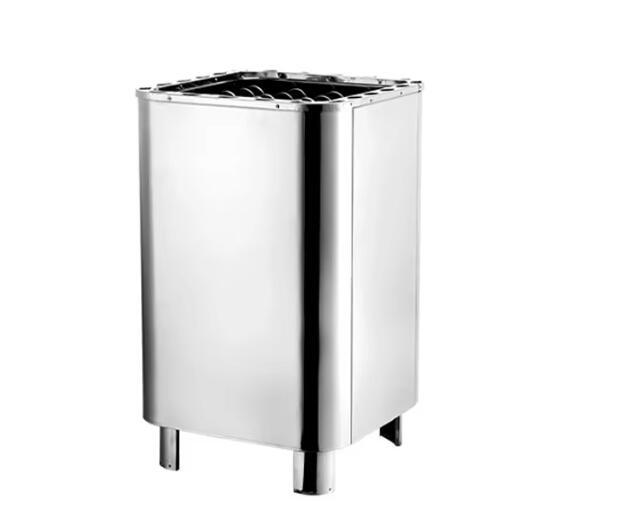
The standard calculation requires 1 kW of power per 45-50 cubic feet of sauna space. This baseline ensures the room reaches optimal temperatures within a reasonable timeframe. You must account for uninsulated surfaces like glass doors or stone walls, which require additional power.
The total kW requirement dictates whether a 220V single-phase system remains viable. If the room volume demands a massive heater, a 380V (or 208V three-phase) system becomes necessary to manage the electrical load safely and efficiently.
| Sauna Volume (Cubic Feet) | Recommended Heater Size (kW) | Typical Voltage Requirement |
|---|---|---|
| 100 - 150 | 3.0 kW - 4.5 kW | 220V / 240V Single Phase |
| 150 - 300 | 6.0 kW - 8.0 kW | 220V / 240V Single Phase |
| 300 - 450 | 9.0 kW - 10.5 kW | 220V / 240V Single Phase |
| 450 - 600+ | 12.0 kW - 15.0 kW | 380V / 208V Three Phase |
You must audit your current electrical panel before purchasing equipment. Check for available amperage and confirm whether you have single-phase or three-phase service. Follow these steps to evaluate your site:
Locate your main electrical panel and read the main breaker rating (e.g., 100A, 200A).
Count the available breaker slots to ensure you have space for a double-pole (220V) or triple-pole (380V) breaker.
Calculate the existing continuous load on the panel to ensure adding a 40-amp or 50-amp sauna circuit will not overload the system.
Measure the distance from the panel to the sauna location to determine the wire run length and account for voltage drop.
Upgrading residential panels presents significant limitations. Moving from a 100-amp to a 200-amp service to accommodate high-draw heaters is expensive and sometimes restricted by local utility infrastructure.
There is a common misconception that 380V heats a room faster than 220V. This is factually incorrect. Heat output is a function of wattage, not voltage. The heating elements convert electrical energy into thermal energy at a fixed rate based on their kW rating.
A 9kW heater at 220V outputs the exact same thermal energy (BTUs) as a 9kW heater at 380V. The room will heat at the exact same rate regardless of the voltage supplying the unit. You are paying for the wattage consumed, and the heat generated is identical.
The speed of heating depends entirely on the kW rating, insulation quality, and proper stone placement. The operational voltage changes how the power is delivered, not the total amount of heat generated. Proper ventilation and rock density play a much larger role in heat-up times than the power supply type.
Comparing the amperage draw reveals the true difference between these systems. A 10kW heater draws roughly 41.6 amps on 240V single-phase, requiring thick, expensive 6 AWG wiring. The same 10kW heater on 380V three-phase draws only about 15 amps per phase, allowing for much thinner wire gauges.
Lower amperage per line on 380V systems reduces thermal stress on internal components, switches, and wiring. This balanced distribution extends the service life of the equipment, which is critical for continuous operations. Thinner wires are also easier to pull through conduit during installation.
| Heater Size (kW) | Voltage / Phase | Approximate Amperage | Required Wire Gauge (AWG) |
|---|---|---|---|
| 9.0 kW | 240V / 1-Phase | 37.5 Amps | 8 AWG |
| 9.0 kW | 380V / 3-Phase | 13.6 Amps | 12 AWG |
| 12.0 kW | 240V / 1-Phase | 50.0 Amps | 6 AWG |
| 12.0 kW | 380V / 3-Phase | 18.2 Amps | 10 AWG |
High-traffic facilities require robust equipment. A Commercial 12KW Electric Sauna Heater is designed for continuous use scenarios where residential units would quickly fail. These environments demand three-phase power to handle the sustained electrical load safely.
Gyms, hotels, and public bathhouses run their saunas for 12 to 18 hours a day. Single-phase 220V contactors will burn out rapidly under this kind of duty cycle. Three-phase 380V or 208V systems distribute the heat and electrical load, preventing premature component failure and reducing maintenance downtime.
Evaluate your existing electrical panel capacity before selecting any equipment.
Calculate your exact cubic footage to determine the precise kW requirement for your room.
Consult a licensed electrician to verify local codes and phase availability at your property.
Match the heater voltage strictly to your building's supply to avoid catastrophic equipment failure.
A: No. The maximum temperature and heat output depend entirely on the kilowatt (kW) rating of the heater, not the voltage. A 9kW 220V heater and a 9kW 380V heater produce the exact same amount of thermal energy.
A: No. Standard wall outlets provide 110V/120V power. A 220V heater requires a dedicated hardwired circuit installed by a licensed electrician directly to your main breaker panel.
A: Operational electricity costs are based on total wattage consumed over time, not voltage. A 10kW heater will cost the same to operate whether it runs on 220V or 380V, assuming identical usage times.
A: Generally, no. Running a 380V three-phase heater on a 240V single-phase system causes severe undervoltage. The elements will barely heat up, and the control boards will likely fail.
A: Three-phase power distributes the electrical load across three wires instead of two. This lowers the amperage per wire, allowing for thinner cables, smaller breakers, and less thermal stress on components during continuous operation.


