Views: 0 Author: Site Editor Publish Time: 2026-08-08 Origin: Site
In the hospitality industry, a broken steam room directly translates to negative guest reviews, refunded spa treatments, and severe reputational damage. Facility managers often make the critical mistake of specifying light-commercial or residential units for continuous operation. These standard units are not built to run for 12 to 24 hours straight in commercial settings. This constant thermal stress leads to premature element burnout and massive scale buildup. You need a technical, engineering-focused framework to evaluate and select equipment built specifically for high-traffic, continuous-duty environments. Selecting the right equipment prevents catastrophic failures and ensures your facility remains operational around the clock.
Sizing is Material-Dependent: True commercial sizing requires calculating adjusted room volume based on surface materials (porous stone vs. acrylic), not just cubic footage.
Scale Management is Non-Negotiable: Continuous use demands automated blowdown/auto-flush valves and integrated water treatment to prevent catastrophic heating element failure.
Redundancy Mitigates Risk: Operating multiple networked generators is often safer for continuous hotel use than relying on a single, massive centralized boiler.
ASME and UL Compliance: Commercial liability requires strict adherence to pressure vessel certifications and local commercial plumbing codes.
Warranty Integrity: Standard residential warranties are voided in commercial environments; true commercial-grade certification is required to protect capital investments.
Continuous use in a commercial context means operating a unit for 14 to 24 hours of sustained performance every single day. Residential units are engineered for a duty cycle of just one to two hours. The thermal stress and component fatigue in a commercial environment will destroy a residential unit within months. Commercial duty cycles require heavy-duty contactors, industrial-grade heating elements, and robust internal wiring to handle constant electrical loads. When you push a residential unit beyond its design limits, the internal contactors fuse, and the heating elements crack under the relentless thermal expansion and contraction.
Installing a non-commercial unit in a 24/7 spa environment immediately voids the manufacturer warranty. Manufacturers track run times through internal logic boards. When they pull the diagnostic data and see continuous operation, they deny the claim. This leaves the property responsible for 100% of the replacement costs. You must specify equipment rated explicitly for commercial application to protect your capital investment. Relying on a residential warranty for a commercial facility is a massive operational risk.
Generator failure carries massive hidden costs. You face emergency maintenance labor rates and expensive replacement parts. You also lose direct spa revenue when guests cancel treatments due to closed facilities. The initial purchase price matters far less than the long-term reliability of the system. You must prioritize operational uptime over upfront savings to run a successful hospitality facility. Every hour the steam room is down, you are losing money and damaging your brand reputation.
| Component | Residential Specification | Commercial Specification |
|---|---|---|
| Heating Elements | Standard Copper | Incoloy 800 or Teflon-Coated |
| Duty Cycle | 1-2 Hours / Day | 14-24 Hours / Day |
| Water Management | Manual Drain Valve | Automated Blowdown / Auto-Flush |
| Contactor Relays | Standard Duty | Heavy-Duty Industrial |
Proper sizing dictates the success of your installation. You start with the standard cubic footage formula by multiplying length, width, and height. However, physical volume is only the baseline. You must apply critical material multipliers to account for heat absorption. Natural stone, marble, and glass block absorb massive amounts of heat. You must add 50% to 100% to your base volume calculation when using these materials. Exterior walls require an additional 20% volume adjustment to compensate for heat loss.
To properly size your steam bath generator, follow these specific steps:
Measure the exact length, width, and height of the steam enclosure in feet.
Multiply these three dimensions to determine the baseline cubic footage.
Identify the primary wall and ceiling materials to determine the correct multiplier.
Add 50% to the baseline volume if the room uses natural stone or marble.
Add an additional 20% if any of the walls are exterior-facing.
Select a generator model that meets or exceeds this final adjusted volume calculation.
Steam line run limits also dictate your equipment choice. You must factor in the maximum physical distance and elevation change between the generator location and the steam cabin. Long runs cause heat loss and line condensation. Keep the generator as close to the room as local codes allow. Insulate all steam lines to maintain temperature and pressure. If you exceed the manufacturer's recommended pipe run length, you will experience poor steam delivery and excessive water pooling at the steam head.
Heating element metallurgy determines the lifespan of your equipment. Standard copper elements suffer from rapid scaling and fail quickly under continuous use. You need Incoloy or Teflon-coated industrial elements designed specifically for continuous thermal cycling. Low-watt density configurations spread the heat over a larger surface area. This design prevents localized boiling and drastically prolongs element life. High-watt density elements burn out rapidly because they concentrate too much heat in a small area, accelerating scale formation.
Water quality directly impacts scale management. An auto-flush or automated blowdown system is absolutely necessary. These systems purge mineral-heavy water daily to prevent scale accumulation. You must also evaluate the need for pre-generator water treatment. Test your local water hardness in grains per gallon (GPG). If your water is hard, you must install water softeners or reverse osmosis systems to protect the generator. Ignoring water quality will destroy even the most robust commercial heating elements.
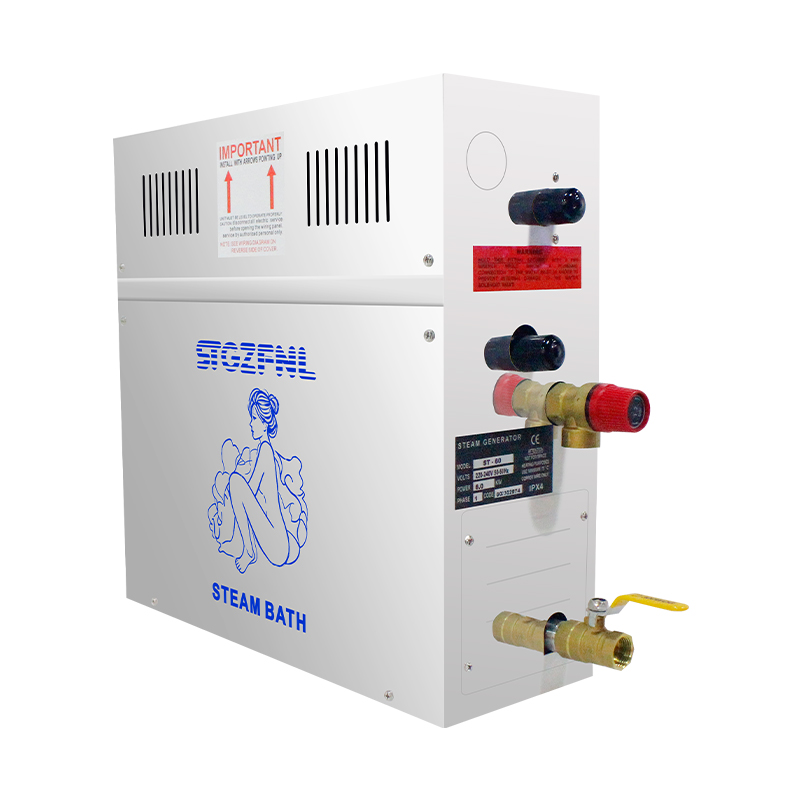
You have several configuration options when designing a commercial steam room. A single high-capacity generator offers simpler initial plumbing and a smaller footprint. However, it presents a single point of failure. If that unit goes down, your steam room closes. Single large units also draw higher peak energy loads, which can strain older electrical panels. You must weigh the simplicity of a single unit against the operational risk of total system failure.
Multi-unit networked systems provide critical redundancy. Linking two or three smaller commercial generators ensures the steam room remains operational. If one unit requires maintenance, the others continue to produce steam. This networked approach keeps your spa open and your guests happy. It represents the safest strategy for continuous hotel use. The initial installation requires more complex plumbing and electrical work, but the operational security is worth the investment.
You must also choose between centralized steam boilers and point-of-use generators. Centralized boilers sit in a main mechanical room and pipe steam across the facility. This keeps maintenance out of the spa area but requires extensive, insulated piping. Point-of-use generators sit near the steam enclosure. They eliminate long pipe runs but require local access panels for maintenance. Evaluate your building layout to determine the best approach for a Professional Steam Bath Machine.
Aroma and essence infusion systems enhance the guest experience. Manual well-style aromatherapy requires constant staff attention and is unsuitable for high-traffic spas. You need automated, inline fragrance injection pumps. These pumps connect directly to the steam line and deliver consistent, metered doses of eucalyptus or lavender without staff intervention. Ensure the injection point is located downstream from the generator to prevent essential oils from backing up into the water tank.
Modern commercial steam systems integrate seamlessly with Building Management Systems (BMS). BACnet or Modbus compatibility allows your engineering team to monitor diagnostics remotely. They can track temperature, monitor run times, and receive fault alerts directly at their control desks. This proactive monitoring prevents minor issues from becoming catastrophic failures. Facility managers can adjust setpoints and monitor water levels without ever stepping foot in the mechanical closet.
Energy conservation features reduce operating costs during off-peak hours. Look for idle modes or smart-steam features. These settings keep the water pre-heated at a lower energy threshold when the room is empty. When a guest enters, the system ramps up instantly to deliver rapid steam. This avoids the continuous full-load power draw of older, less intelligent systems. Implementing these features significantly reduces electrical consumption while maintaining immediate steam availability for your guests.
Guest controls must be tamper-proof. You cannot allow users to adjust the maximum temperature in a commercial setting. Lock out temperature adjustments from the user side to prevent safety hazards. Provide simple, waterproof on/off actuation inside the cabin. This gives guests control over their immediate experience while keeping the facility safe and compliant. The main temperature controller should be located at the spa reception desk or in a locked mechanical room.
Commercial steam systems require specific electrical and plumbing prerequisites. High-kilowatt units demand 3-phase commercial power. Single-phase power simply cannot support the amperage required for large commercial rooms. Verify your electrical panel capacity with an MEP engineer before purchasing any equipment. Upgrading a building's electrical service to support a new steam generator is a massive expense that must be identified early in the planning phase.
Drainage requirements are equally strict. High-temperature blowdown water cannot go directly into standard PVC pipes. You must provide indirect waste connections and air gaps to comply with commercial plumbing codes. Plan your footprint carefully. Specify the physical clearance needed around the generator. Technicians need space to extract heating elements and perform routine servicing. If you install the unit in a cramped space, routine maintenance becomes impossible, leading to premature equipment failure.
Ventilation and steam head placement dictate guest safety. Locate steam heads away from seating areas to prevent severe burns. Install baffle guards and specify cool-touch technology for all exposed components. Larger layouts require multi-head steam distribution to ensure uniform heat levels across the room. You must also design sloped ceilings to prevent hot water from dripping onto guests. Proper exhaust ventilation is mandatory to stop moisture migration into the rest of your facility. Without adequate exhaust, humidity will destroy adjacent drywall and ceiling tiles.
Compliance and certifications protect your business from liability. You must specify units with ASME (American Society of Mechanical Engineers) boiler certifications. Look for UL or CSA listings on all electrical components. Adhere strictly to local municipal codes during installation. Failing to meet these standards exposes your property to massive legal and financial risks. Building inspectors will shut down your facility if they discover non-compliant pressure vessels operating in a commercial space.
Filter your equipment choices first by ASME compliance and strict commercial warranty coverage.
Calculate your room volume accurately by applying the correct material multipliers for stone or tile.
Specify automated maintenance features like auto-flush valves to handle daily scale management.
Conduct a professional water hardness test to determine if pre-treatment is necessary.
Consult with an MEP engineer to verify 3-phase electrical capacity and proper high-temperature drainage.
A: Multiply the room's length, width, and height to find the cubic footage. Then, add material multipliers. Add 50% to 100% for natural stone or marble, and add 20% for exterior walls to ensure adequate heating capacity.
A: With proper water treatment and daily automated blowdowns, a commercial unit can last 5 to 10 years. Neglecting scale management or using residential units will reduce this lifespan to mere months.
A: Continuous boiling concentrates minerals in the water tank. An auto-flush system purges this mineral-heavy water daily. This prevents severe scale buildup that destroys heating elements and clogs valves.
A: Yes. Modern commercial units feature BACnet or Modbus compatibility. This allows facility engineers to monitor temperatures, track diagnostics, and receive fault alerts remotely.
A: Single-phase units are typically for residential or light use. 3-phase generators handle higher electrical loads efficiently, making them mandatory for high-kilowatt commercial units operating continuously.
A: Even with auto-flush systems, commercial units require manual descaling every 3 to 6 months. The exact frequency depends on local water hardness and the presence of pre-treatment systems.
A: Yes. Manufacturers track operational hours. Running a residential unit in a 24/7 commercial environment instantly voids the warranty, leaving you responsible for all replacement costs.


