Views: 0 Author: Site Editor Publish Time: 2026-08-06 Origin: Site
Specifying the correct electrical requirements for commercial wellness facilities is a critical step that dictates equipment longevity, safety, and operational efficiency. Incorrect voltage specifications can lead to massive retrofit costs, blown breakers, or catastrophic equipment failure. When designing a steam room for a hotel, gym, or spa, facility managers, architects, and MEP engineers must balance rapid heating demands with the physical limitations of their building's existing electrical infrastructure. The technical evaluation of 220V versus 380V systems is essential. The correct choice depends on room volume, continuous operational demands, phase availability, and installation constraints. Choosing the right power supply for a steam bath generator ensures reliable steam production while keeping electrical loads manageable and safe. We will break down the engineering realities of both voltage types to guide your facility planning.
Amperage and Wire Sizing: 380V systems draw significantly less amperage than 220V systems for the same kilowatt (kW) output, allowing for smaller wire gauges and reducing heat generation in the electrical conduits.
Phase Availability: 380V is exclusively three-phase power (common in industrial/large commercial spaces), whereas 220V can be configured as single-phase or three-phase depending on the specific professional steam bath machine.
Operational Scale: 220V is generally sufficient for boutique spas and smaller hotel installations, while 380V is the standard for high-traffic, continuous-run environments like large health clubs.
Infrastructure Costs: Upgrading a facility to support 380V three-phase power can be prohibitively expensive if not already present, making existing grid capacity the primary limiting factor in procurement.
The relationship between room volume, required kW rating, and electrical load determines the necessary power supply. Larger cubic footage requires higher kW ratings to heat the space efficiently. A 500-cubic-foot room finished in porous natural stone might require a 24kW unit, whereas the same room finished in acrylic might only need a 12kW unit. As kW requirements increase, standard voltage often becomes insufficient. Pushing 24kW through a standard low-voltage line creates massive amperage draw. This forces a transition to higher voltage to keep amperage manageable, prevent electrical strain, and avoid melting terminal blocks.
Engineers must calculate the exact cubic footage and apply a multiplier based on the wall materials. Glass blocks, exterior walls, and high ceilings all increase the required kW. Once the kW exceeds 15kW, the electrical load on a standard 220V single-phase panel becomes a significant burden, often requiring dedicated sub-panels just to handle the single appliance.
Single-phase power is typical in residential and light commercial settings, utilizing two hot legs and a ground. Three-phase power handles heavy commercial loads by utilizing three distinct alternating currents that peak at different times. Common commercial configurations include 220V single-phase, 220V three-phase, and 380V three-phase. Three-phase power delivers continuous, non-pulsating power transfer. This reduces thermal and mechanical strain on the heating elements of the steam bath generator.
When a single-phase element heats up, it experiences micro-fluctuations in power delivery. Over thousands of hours, this causes metal fatigue. Three-phase elements receive a constant, overlapping supply of power, allowing them to maintain a steady temperature with less expansion and contraction. This fundamental difference is why heavy commercial facilities almost exclusively rely on three-phase infrastructure for heating appliances.
Doubling the voltage roughly halves the amperage for the same wattage. Lower amperage directly impacts breaker sizing and copper wiring requirements. For example, a 12kW unit on 220V single-phase draws roughly 54 amps, requiring a 70-amp breaker and thick 4 AWG copper wire. That same 12kW unit on 380V three-phase draws only about 18 amps per leg, allowing for a 25-amp breaker and much thinner 10 AWG wire.
This reduction in amperage simplifies installation and reduces material expenses. Pulling thick 4 AWG wire through long conduit runs is labor-intensive and requires larger conduit pipes. Thinner wire is easier to bend, easier to terminate, and generates significantly less heat inside the conduit, reducing the risk of insulation degradation over time.
220V systems are ideal for boutique gyms, day spas, and executive locker rooms with intermittent use. These facilities typically do not have the heavy industrial power infrastructure required for 380V. 220V units are highly efficient in the typical kW range of under 12kW to 15kW, providing adequate steam production for smaller rooms that are only activated upon client request.
In these environments, the steam room might run for four to six hours a day. The electrical panels in these buildings are usually equipped to handle 220V single-phase or 208V three-phase loads without requiring expensive utility upgrades. A Professional Steam Bath Machine rated for 220V fits seamlessly into this existing infrastructure.
Installing a 220V system requires specific breaker configurations, such as dual-pole breakers in single-phase commercial panels. As the kW rating scales up on a 220V system, heavier gauge wiring becomes necessary to mitigate resistance and voltage drop. If the electrical panel is located 100 feet away from the mechanical room, the voltage drop on a high-amperage 220V line can be substantial, requiring even thicker wire to compensate.
Electricians must carefully torque the connections on high-amperage 220V units. Loose connections on a line carrying 60+ amps will quickly arc, overheat, and melt the terminal block. Regular maintenance checks are required to ensure these connections remain tight after the initial break-in period.
When a high-kW 220V unit runs continuously for 12+ hours, thermal strain on wiring and contactors increases significantly. The contactors, which act as heavy-duty relays to send power to the elements, take a massive beating when switching high amperage loads. Over time, the contact points pit and degrade, leading to failure.
Lower-voltage systems also face limitations in heat-up speed and sustained steam output compared to higher-voltage industrial units. If a large commercial steam room door is constantly opening and closing, a 220V system may struggle to recover the lost heat quickly enough, resulting in a lukewarm room and dissatisfied guests.
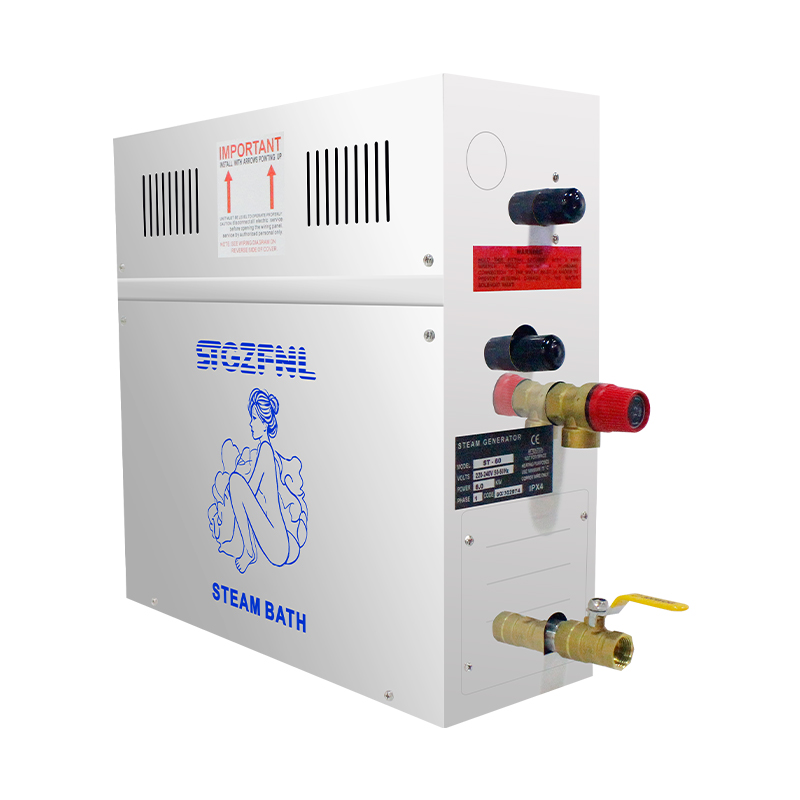
380V three-phase systems distribute the electrical load across three distinct legs, drastically lowering the amperage per line. This reduced heat generation extends the longevity of internal components, including contactors, heating elements, and terminal blocks. Because the amperage is lower, the contactors do not arc as violently when they engage and disengage, resulting in a lifespan that can be double or triple that of a 220V equivalent.
The heating elements themselves also benefit. The steady, overlapping power delivery of three-phase electricity means the elements maintain a more consistent surface temperature. This reduces the rapid expansion and contraction that causes element sheaths to crack and fail prematurely.
Target environments for 380V systems include large-scale health clubs, resort spas, and facilities requiring 24/7 continuous steam production. These locations demand relentless reliability. They are highly suitable for multi-room steam setups driven by a single, high-capacity Professional Steam Bath Machine.
In a mega-gym where the steam room is a primary amenity, downtime is unacceptable. 380V systems are built for this exact scenario. They can run continuously, recovering room temperature rapidly even during peak hours when the door is constantly in motion.
Commercial building grids vary globally; 380V is standard in many international markets, while the US often utilizes 208V or 480V three-phase. Operating imported European-spec 380V/400V equipment on North American electrical infrastructures requires careful compatibility checks. You cannot simply wire a 380V machine into a 480V panel without catastrophic results.
Installing step-up or step-down transformers involves significant cost implications if the building's native supply does not match the generator. A heavy-duty dry-type transformer required to step 208V up to 380V is large, heavy, generates its own heat, and requires dedicated floor space and ventilation in the mechanical room.
Matching cubic footage and wall materials to the required kW is crucial. Natural stone requires higher kW than tile because it absorbs massive amounts of thermal energy before the room air can reach the target temperature. Selecting the optimal voltage ensures rapid heat-up times and consistent steam quality based on the specific room dynamics.
| Room Volume (Cu. Ft.) | Wall Material | Recommended kW | Optimal Voltage |
|---|---|---|---|
| 200 - 300 | Acrylic / Fiberglass | 7.5kW - 9kW | 220V Single-Phase |
| 300 - 450 | Ceramic Tile | 12kW - 15kW | 220V Single/Three-Phase |
| 450 - 600 | Natural Stone | 18kW - 24kW | 380V Three-Phase |
| 600+ | Heavy Stone / Glass | 24kW - 36kW+ | 380V Three-Phase |
Comparing upfront equipment costs against hidden installation expenses is necessary. Consider copper wire pricing, specialized three-phase breakers, and electrician labor hours when deciding between a 380V and a 220V steam bath generator. While a 380V unit might have a higher initial purchase price, the savings on thinner copper wire and smaller conduit can offset that difference in large commercial builds.
Conversely, if a building only has 220V single-phase power available, the cost to bring three-phase power into the building from the street will far exceed any savings on wire. In that scenario, installing multiple smaller 220V units might be the only viable engineering solution.
Evaluating duty cycles guides the voltage decision. If the unit runs more than 10 hours daily, the component longevity of a 380V system yields better long-term reliability and operational stability. Intermittent use facilities can comfortably rely on 220V systems without experiencing accelerated component wear.
In the US market, 208V and 240V are common, while true 220V or 380V may require specific equipment ratings or transformers. Running a 240V rated machine on a 208V supply causes approximately a 25% loss in heating capacity and slower steam production. This is a common failure point in commercial installations where the MEP engineer specifies a 240V unit, but the building only supplies 208V three-phase.
The result is a steam room that never reaches the set temperature, leading to endless service calls. Always verify the actual line voltage with a multimeter before ordering equipment.
Specifying an oversized unit leads to rapid short-cycling, rapid component wear, poor steam quality, and unnecessary electrical panel spikes. Proper sizing prevents structural dangers and ensures efficient operation. When an oversized unit fires up, it fills the room with steam too quickly, hits the temperature setpoint, and shuts off immediately.
This short-cycling causes the room to experience wild temperature swings. The contactors click on and off constantly, burning out prematurely. The steam quality suffers because the room never achieves a steady, rolling boil effect. Precision sizing is far more important than simply buying the largest unit available.
A dual-source wiring requirement isolates the high-voltage heating loop from the dedicated, low-voltage control line. This separation protects sensitive digital control panels, thermostat sensors, auto-flush solenoid valves, and LED lighting systems from high-voltage surges.
Running the control circuits on a separate 120V line ensures that if a high-voltage heating element shorts out, it does not fry the expensive digital motherboard. This isolation is a standard requirement in heavy commercial equipment and must be planned for in the electrical schematic.
Active physical testing of the on-site power supply under load before purchasing or wiring a Professional Steam Bath Machine prevents mismatch issues on startup. Verifying actual line voltage against the nameplate rating is a mandatory step.
Measure voltage across all legs with a true RMS multimeter.
Verify the presence of a dedicated neutral line if required by the control circuit.
Confirm the breaker size matches the manufacturer's maximum overcurrent protection rating.
Inspect the conduit run length to calculate potential voltage drop.
Ensure the mechanical room has adequate ventilation to dissipate ambient heat from the generator casing.
The choice between 220V and 380V is a strict engineering decision dictated by room volume, required kW, and existing facility infrastructure. Recommend 220V for sub-15kW needs in standard commercial spaces, and 380V for high-capacity, continuous-use environments where three-phase power is already available.
Hire a licensed commercial electrician to audit your current panel capacity and available phase configuration.
Calculate the exact cubic footage of your steam room, factoring in wall materials to determine the precise kW requirement.
Measure the exact line voltage in the mechanical room under load to prevent voltage mismatch.
Cross-reference your facility's electrical data with the manufacturer’s specification sheets before finalizing procurement.
A: No, a 380V unit requires a specific three-phase power supply and cannot operate on a standard 220V single-phase line without a step-up transformer, which is often impractical and expensive.
A: A 380V system draws lower amperage for the same kW output, allowing for smaller, thinner wire gauges compared to a 220V system, which requires thicker wires to handle higher amperage safely.
A: Yes, but performance will degrade. Running a 220V/240V rated unit on 208V typically results in about a 25% reduction in heating capacity and slower steam production.
A: Yes, but it requires installing a step-up transformer to convert the local 208V or 240V supply to the required 380V, adding significant installation costs and space requirements.
A: Yes, commercial units typically require a dedicated low-voltage line (often 120V) to isolate and protect sensitive digital controls and sensors from the high-voltage heating loop.


