Views: 0 Author: Site Editor Publish Time: 2026-07-03 Origin: Site
The sauna heater operates as the beating heart of any authentic sauna experience. When you evaluate your options, you often face a difficult choice between premium stainless steel and cheaper budget metals. This critical decision dictates the safety, performance, and entire lifespan of your setup.
A true dry steam room creates an extreme operational environment for any metal. High peak temperatures push materials to their absolute limits. This intense heat is immediately followed by sudden thermal shock when you splash water over the rocks. Inferior metals warp, rust, or degrade rapidly under this relentless cycle.
This guide unpacks why an SS304 sauna stove remains the industry standard for safety, longevity, and reliable performance. We will explore the unique engineering benefits of marine-grade alloys in extreme heat. You will also learn how to evaluate a manufacturer's build quality before you finalize your purchase.
Material Reliability: SS304 (Grade 304 Stainless Steel) offers the optimal balance of corrosion resistance and thermal stability, preventing the rust and warping common in inferior metals.
Health & Safety: Unlike galvanized metals, SS304 produces zero toxic off-gassing under extreme heat, mitigating critical respiratory risks.
Manufacturing Over Material: Raw material is only half the equation; high-quality TIG welding and structural engineering are required to handle metal expansion.
Traditional sauna stoves face relentless cycles of thermal expansion and contraction. Heating a room to 190°F causes metal components to swell. Cooling them down causes rapid shrinkage. When you add water to create löyly (steam), you introduce high humidity to this volatile mix. Untreated mild steel quickly succumbs to rapid oxidation in these conditions. Paint peels away. Rust inevitably takes over. This degradation weakens the structural integrity of the entire heating unit.
Grade 304 stainless steel offers a profound engineering advantage. It relies on a specific 18/8 composition. This means it contains 18% chromium and 8% nickel. The high chromium content allows the metal to form a passive oxide layer on its surface. If you scratch the stove, this microscopic layer instantly self-heals in the presence of oxygen. The nickel content provides vital ductility. It allows the metal to flex under extreme heat without snapping. This unique alloy resists "thermal fatigue" far better than low-grade 400-series stainless steel. It drastically outperforms untreated mild steel.
We must also address a critical health and safety mandate. DIY sauna builders and budget manufacturers sometimes use galvanized steel to save money. Galvanized steel contains a zinc coating. Zinc vaporizes at high temperatures. This vaporization releases highly toxic fumes into the enclosed sauna cabin. Inhaling these fumes causes metal fume fever, posing severe respiratory hazards. SS304 remains chemically stable at peak operational temperatures. It produces zero toxic off-gassing. Choosing this alloy establishes a chemically stable baseline for pure, safe air quality during your sessions.
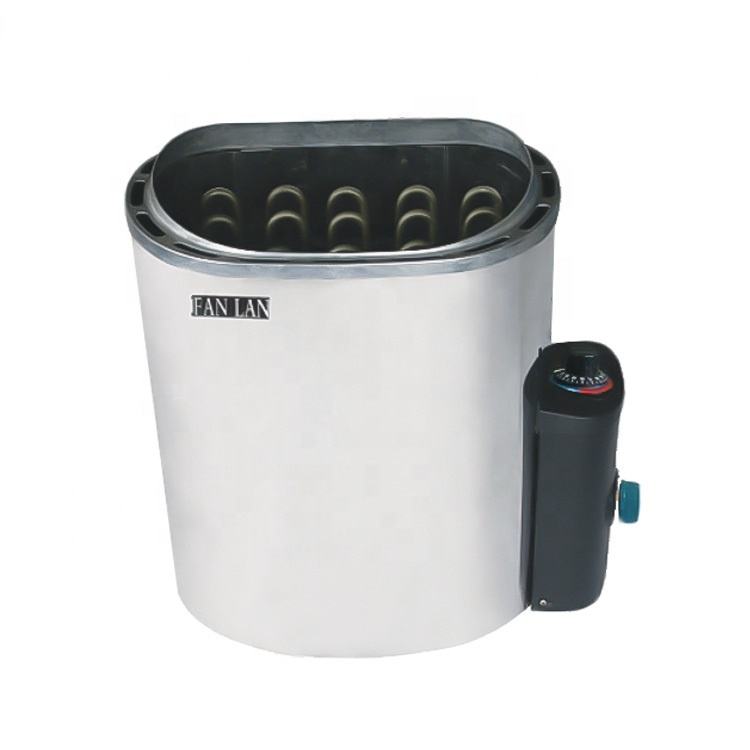
The metal you choose directly impacts how your sauna actually feels. A well-engineered stove regulates heat effectively. Performance metrics go beyond simple temperature readouts. They encompass heat quality, steam generation, and atmospheric consistency.
Handling thermal shock separates premium equipment from disposable units. A true dry steam sauna stove must survive brutal temperature swings. During a session, you regularly throw cold water onto rocks exceeding 200°F. The water flashes into steam instantly. This phase change strips massive amounts of heat from the surrounding environment. The stove casing experiences rapid, localized cooling. Low-grade steel buckles under this sudden temperature drop. The SS304 alloy absorbs this shock smoothly. It prevents the casing from cracking. It strongly resists permanent warping over decades of use.
Heat distribution is another vital performance factor. SS304 features an excellent thermal conductivity profile. It contains the intense heat generated by the elements. It transfers this energy efficiently into the rock basket. Cheap metal casings often fail to contain the energy. They radiate harsh, unregulated infrared heat directly at the bathers. This creates a biting, uncomfortable sensation on the skin. A thick SS304 casing acts as a proper thermal envelope. It forces the heat upward through the stones. The stones then emit a soft, deeply penetrating, and comfortable heat into the room.
Buying a stove simply because a label claims "SS304" presents a dangerous trap. The raw material is only half the equation. The assembly method dictates the true lifespan of your equipment. You must examine the construction techniques rigorously.
Weld integrity stands as the most critical failure point. High temperatures cause metal plates to pull against each other. Top-tier manufacturers use TIG (Tungsten Inert Gas) welding exclusively. TIG welding fuses the metal joints seamlessly. It creates a bond as strong as the base metal itself. Budget manufacturers rely on cheaper spot-welding. Spot welds merely pinch two pieces of metal together at isolated points. When the metal expands, these tiny weld points snap. Structural failure follows shortly after.
You must also establish strict baselines for metal gauge, or thickness. Paper-thin SS304 will still warp under commercial or heavy residential use. Look for robust construction to ensure long-term stability.
Verify the gauge: Ensure the main casing uses 16-gauge (1.5mm) or thicker stainless steel.
Inspect the rock basket: The stone compartment should feature heavy-duty grates to support 40-100 lbs of rock weight.
Check the element housing: The internal dividers must separate the rocks from direct contact with the heating elements.
Airflow engineering represents the final hallmark of quality. Expert manufacturers design the SS304 rock basket to promote natural convection. Cold air pulls from the floor. It passes rapidly over the internal heating elements. The air heats up and shoots out the top of the stove. Proper spacing inside the chassis prevents the elements from suffocating. Unrestricted airflow cools the elements just enough to prevent them from burning out prematurely. This extends their operational life significantly.
You must match the stove accurately to your specific room requirements. An undersized heater runs constantly, burning out its elements. An oversized heater short-cycles, heating the air before the rocks get hot enough to produce good steam.
The standard volume-to-power ratio provides your baseline. You generally need 1 kW of power for every 45 to 50 cubic feet of interior room volume. First, multiply your room's length, width, and height to find the base cubic footage. However, this base calculation assumes perfect insulation.
You must apply the "glass and stone penalty" to your calculations. Uninsulated surfaces drain heat quickly. For every square meter (about 10 square feet) of glass door, window, tile, or exposed concrete, you must add 1.2 cubic meters (about 42 cubic feet) to your total calculated volume. Failure to account for uninsulated surfaces guarantees an underperforming sauna.
You will also need to choose between electric and wood-burning models. Both shine when constructed from heavy-duty SS304, but they serve different logistical needs.
| Feature | Electric SS304 Stove | Wood-Burning SS304 Stove |
|---|---|---|
| Temperature Control | Highly precise, often includes digital timers and thermostats. | Manual control, requires active fire management. |
| Installation Logistics | Requires a dedicated 220V/240V electrical hardwire connection. | Requires a chimney system, flue pipe, and roof flashing. |
| Clearance Requirements | Minimal clearances needed; can sit closer to wooden benches. | Strict safety clearances required; needs heat shields. |
| Best Application | Urban homes, indoor setups, commercial gyms. | Remote cabins, outdoor barrel saunas, off-grid locations. |
Proper expectation management ensures you remain satisfied with your purchase for decades. You need to know exactly what happens to the metal post-purchase. High heat changes the physical appearance of stainless steel.
You will experience aesthetic changes known as "heat tint" or "bluing." When subjected to 500°F+ temperatures, the chromium oxide layer on the SS304 thickens. This thickened layer refracts light differently. Your bright silver stove will naturally develop bronze, blue, or purple hues near the hottest zones. This represents a natural oxidation process. It is a protective layer, not a structural defect. You should embrace this patina as the mark of a well-used sauna.
Scale and water deposits require careful maintenance. Splashing water inevitably leaves white calcium and mineral traces on the exterior casing. You must clean these deposits correctly. Never use abrasive steel wool or harsh wire brushes. These tools will scratch the metal and destroy the protective chromium oxide layer. Instead, use a mild citric acid solution or white vinegar. Let the liquid sit on the mineral spots for ten minutes. Wipe the surface gently with a soft microfiber cloth.
Finally, understand the difference between element lifespan and casing lifespan. The SS304 casing will likely outlast the room itself, easily enduring for decades. However, internal electric heating elements remain consumable parts. The intense thermal cycling eventually causes them to fail. You should always select brands that utilize universal or easily replaceable elements. A modular design allows you to swap out a burnt element in ten minutes, keeping your premium SS304 chassis in service indefinitely.
Investing in an SS304 stove serves as a fundamental requirement for longevity and safety. The extreme heat and high moisture of a dry steam environment will rapidly destroy lesser materials. The 18/8 chromium-nickel alloy protects against thermal fatigue and guarantees a pure, safe breathing environment free from toxic off-gassing.
Your next steps dictate the success of your installation. First, calculate your exact cubic footage carefully, making sure to apply the appropriate penalties for glass doors and uninsulated stone. Second, finalize your power source based on your venting and electrical capabilities. Finally, look closely at the manufacturing details. Demand specific gauge measurements and insist on TIG-welded construction when evaluating your shortlisted brands.
A: SS316 offers higher corrosion resistance because it contains molybdenum. This makes it superior for harsh marine environments or saltwater exposure. However, SS304 is structurally sufficient and far more practical for 99% of residential and commercial saunas. SS316 is generally over-engineered for standard steam applications.
A: No. Even if you never splash water on the rocks, human sweat and natural ambient humidity introduce moisture. When combined with extreme heat cycles, this moisture will eventually rust mild steel. SS304 is strictly recommended to prevent long-term degradation and ensure safe air quality.
A: This coloration is called heat tinting, or thermal oxidation. The extreme heat naturally thickens the protective chromium oxide layer on the stainless steel. It refracts light, causing blue or bronze hues. This is completely normal and does not compromise the structural integrity or safety of your stove.


