Views: 0 Author: Site Editor Publish Time: 2026-07-19 Origin: Site
In commercial hospitality and wellness settings, a steam room acts as a major guest draw. However, frequent equipment downtime translates directly into negative reviews, frustrated users, and damaged brand reputation.
You cannot simply scale up residential units to handle high-traffic spa environments. Selecting the proper steam bath generator demands careful evaluation of duty cycles, material-adjusted room sizing, and heavy-duty maintenance capabilities. Without this engineering rigor, facilities often face rapid hardware failure, increased liability, and unpredictable outages.
This comprehensive guide provides a vendor-neutral framework to help you evaluate and select the best commercial systems. You will discover the exact sizing formulas needed for different wall materials. We also outline the architectural requirements and critical automated features you must demand. By following these principles, you ensure high uptime, regulatory compliance, and a flawless wellness experience for every guest.
Commercial steam bath generators must be rated for continuous daily operation, unlike residential units built for intermittent use.
Room volume calculations must account for wall materials; porous surfaces like marble or glass require significantly higher kW output than acrylic or ceramic tile.
Automated maintenance features (like auto-flush) and fast-steam capabilities are mandatory for minimizing facility labor and operational bottlenecks.
Total Cost of Ownership (TCO) relies heavily on local water quality; integrating proper water softening prevents premature heating element failure.
Business owners often make a critical engineering error during wellness center build-outs. They install standard residential generators inside high-traffic spas or hotels. This mismatch leads to rapid component burnout, voided manufacturer warranties, and unacceptable downtime. A standard machine simply lacks the physical infrastructure to handle commercial demands.
The primary difference lies in the duty cycle. Manufacturers engineer residential models for intermittent operation. They typically run for 30 to 60 minutes per day. Once a homeowner finishes their session, the machine cools down entirely. These residential models use smaller water reservoirs and standard-grade heating elements.
Commercial units operate under entirely different expectations. Engineers build them for up to 24/7 continuous output. A commercial generator features heavy-duty Incoloy heating elements capable of enduring constant thermal stress. The water tanks are significantly larger. The internal contactors and relays can handle thousands of switching cycles without degrading. When you operate a wellness center, your equipment must deliver consistent steam from early morning until late evening.
Compliance and liability present another major dividing line. Commercial environments carry strict regulatory requirements. You must select units carrying specific UL (Underwriters Laboratories) or CE certifications for commercial use. Facility insurance policies mandate these certifications. Local building codes also require them. Installing a residential unit in a commercial space often violates fire codes. It also exposes your business to massive liability claims if an accident occurs.
Always request the manufacturer's official commercial rating certificate.
Verify the unit explicitly supports continuous, all-day operation.
Ensure your facility meets the voltage requirements (typically 208V or 240V three-phase) for commercial power draw.
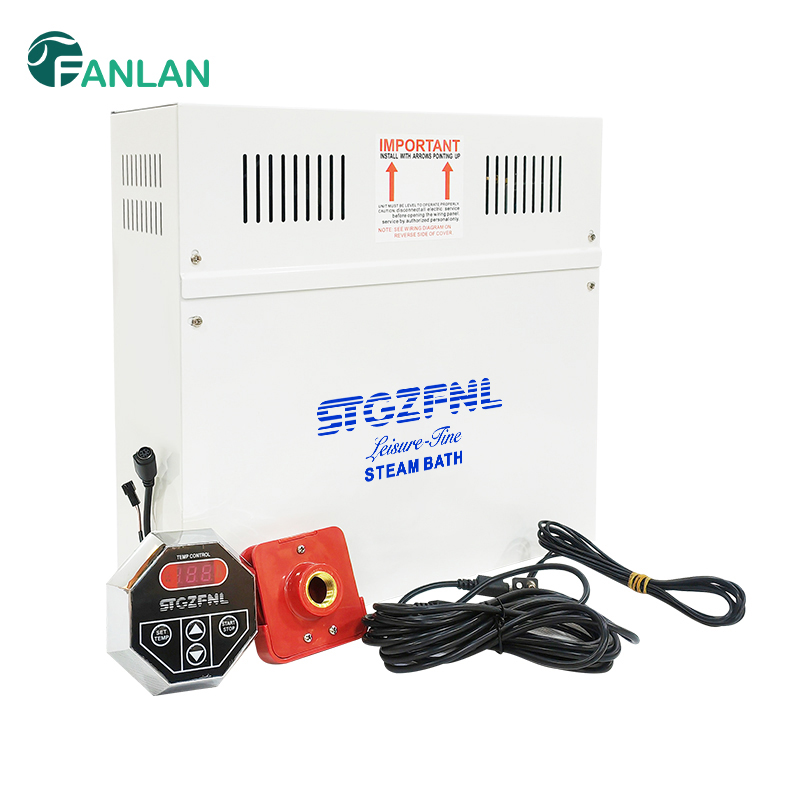
Selecting the correct kilowatt (kW) output dictates the success of your installation. You must look beyond the simple physical dimensions of the room. Commercial sizing relies on a specialized formula known as "Adjusted Cubic Footage." This approach ensures your system delivers dense, consistent steam regardless of the enclosure's architectural finishes.
First, calculate your baseline volume. Multiply the room's length, width, and height in feet. You should never design a commercial steam room ceiling higher than 8 feet. Heat naturally rises. If you build a 10-foot ceiling, the hottest steam pools above the users' heads. This wastes energy and leaves the bench area too cool for comfort.
Next, apply the material compensation factor. Wall materials drastically impact heat retention. Non-porous materials like acrylic, fiberglass, or standard ceramic tile absorb very little heat. They require minimal to no volume adjustment. However, luxury spas frequently use porous materials. Natural stone, marble, glass blocks, and concrete absorb heat rapidly. They pull thermal energy out of the steam. You must mathematically compensate for this thermal drain when selecting your steam room equipment.
If you have exterior-facing walls, you must account for seasonal temperature drops. Add a 10% to 20% multiplier per exterior wall to offset ambient heat loss.
| Material Type | Heat Absorption Level | Required Volume Multiplier |
|---|---|---|
| Acrylic / Fiberglass | Very Low | 0% (Use base volume) |
| Standard Ceramic Tile | Low | +10% to +20% |
| Glass Block / Glass Walls | High | +40% to +50% |
| Natural Stone / Marble | Very High | +50% to +100% |
| Exterior Facing Wall | Variable | +10% to +20% per wall |
Failing to apply these multipliers creates severe operational risks. Choosing a unit based strictly on physical volume without material compensation causes chronic undersizing. An undersized generator runs continuously. It strains internal components. Most importantly, it never reaches the target temperature, leaving your guests shivering in a lukewarm, foggy room.
Operating a steam room at a commercial scale requires advanced automation. You cannot rely on staff to manually manage equipment multiple times a day. Modern generators incorporate specific technologies designed to streamline operations, enhance guest satisfaction, and reduce maintenance burdens.
Fast-steam technology stands out as a critical operational feature. Traditional residential units often take 10 to 15 minutes to boil water and produce steam. In a busy spa, guests will not wait. Fast-steam systems maintain the internal water tank at a pre-heated, near-boiling state. When a guest presses the start button, the unit delivers thick steam within seconds. This eliminates wait times. It also reduces energy waste during off-peak hours because the machine only produces full steam on demand.
Automated maintenance represents another non-negotiable feature. Water naturally contains minerals like calcium and magnesium. When water boils into steam, these minerals remain behind. They form hard scale on the heating elements. An auto-flush system combats this automatically. It drains and flushes the entire tank after each use cycle or at programmed intervals. This process forcefully expels scale-causing minerals before they solidify. Auto-flush drastically extends the lifespan of the generator. It also removes the need for daily manual tank draining by your maintenance staff.
Facility managers require deep visibility into equipment status. Smart diagnostics and facility integration provide this oversight. Look for digital control panels offering clear error-code readouts. Advanced commercial units integrate directly into a Building Management System (BMS). Using protocols like BACnet or Modbus, these systems send real-time data to a central dashboard. Facility managers can monitor temperatures, track usage patterns, and troubleshoot minor issues remotely before they escalate into complete outages.
Ignoring the auto-flush requirement in hard-water regions, leading to element failure within months.
Purchasing units lacking BMS connectivity, forcing staff to physically inspect mechanical rooms daily.
Turning off fast-steam features to save minimal power, resulting in guest complaints about cold rooms.
Even the most powerful generator will fail if the room architecture falls short. Steam is an incredibly invasive force. It exploits every structural weakness. Proper installation requires strict adherence to thermodynamics and vapor management principles.
First, address the ceiling slope. Steam naturally condenses on cooler surfaces. If you build a flat ceiling, this condensation forms heavy water droplets. These droplets will eventually rain down on users. Falling scalding water ruins the relaxing experience instantly. To prevent this, you must construct a sloped ceiling. The industry standard requires a slope of 2 inches per linear foot. This geometry forces condensation to glide smoothly down the walls instead of dripping onto the benches.
Next, focus on vapor proofing. A steam room must be a 100% vapor-tight enclosure. Moisture will penetrate standard drywall or improper grout, feeding hidden structural mold. You must install a continuous, high-grade vapor barrier behind the cement board. Ensure your contractors apply proper sealing around doors, hinges, and lighting fixtures. Specialized vapor-proof lighting is legally required for wet environments.
Follow strict generator placement rules during installation:
Distance: Install the generator within 25 to 50 feet of the steam head. Placing it further causes the steam to cool and condense inside the pipe before reaching the room.
Location: Never install the generator inside the steam room itself. Place it in a dedicated mechanical room, heated attic, or accessible utility closet.
Accessibility: Leave adequate clearance around the unit. Technicians need easy access to the panels to swap heating elements or perform routine descaling.
Prioritize specific safety features to protect your guests. The steam head itself gets incredibly hot. Choose cool-to-the-touch steam heads or install physical guards around the emission point. Facilities must install emergency shut-off switches both inside and outside the room. Finally, precise thermostatic controls are vital. The system must instantly halt steam production if the room exceeds the safe maximum temperature, preventing accidental scalding.
Commercial operators must evaluate hardware based on its operational lifespan and maintenance demands. Evaluating the upfront hardware specifications against commercial warranty terms reveals the true durability of the system. Commercial warranties differ vastly from residential ones. You must review both parts and labor coverage. A strong warranty indicates the manufacturer trusts their components under heavy daily stress.
Water quality stands as the single biggest variable in equipment longevity. We must address a universal truth: no generator is immune to hard water. Mineral buildup destroys heating elements faster than any other factor. Before installation, you must test your facility's water hardness. Measure the GPG (grains per gallon). If your water tests high for minerals, you face an immediate mechanical threat.
Actionable advice dictates treating your water proactively. Implementing a dedicated water softener or a specialized filtration system prevents premature breakdown. Treating the water before it enters the generator protects your mechanical investment. It reduces the frequency of manual descaling procedures and ensures consistent steam output year-round.
Operational efficiency also hinges on smart power management. Modern commercial units utilize proportional heating technology. They feature multi-element designs. When the room is cold, all elements fire simultaneously to reach the target temperature rapidly. Once the room hits the desired heat level, the system steps down the power. It turns off most elements, using just one to maintain the temperature. This intelligent cycling reduces the mechanical strain on individual components. It also minimizes long-term energy consumption for hotels running systems continuously throughout the day.
Creating a premium commercial steam experience demands precise engineering and careful equipment selection. Sizing your unit accurately for wall materials ensures optimal temperatures and dense steam production. Investing in commercial-grade architecture prevents structural damage and guarantees continuous, uninterrupted use. Furthermore, prioritizing automated maintenance features like auto-flush and smart diagnostics significantly reduces your facility's daily labor burden.
Take decisive action before purchasing your equipment. First, audit your exact room dimensions and catalog every interior wall material. Second, test your facility's local water hardness to determine your filtration needs. Finally, consult directly with a specialized commercial vendor. They will help you generate a customized kW requirement and a sustainable operational plan tailored specifically to your wellness center.
A: With routine descaling and proper water filtration, commercial units typically last 5 to 10 years under heavy use. Individual heating elements may require periodic replacement depending on local water hardness and daily operating hours.
A: No. Each steam room requires its own dedicated generator and sensor system. This ensures the equipment accurately manages the specific temperature, cubic footage, and steam flow for that individual enclosure.
A: Yes. Commercial steam room equipment requires dedicated 208V or 240V circuits. Large facilities often require 3-phase power. A licensed electrician must hardwire the system to meet local commercial building codes safely.
A: This typically occurs due to undersizing the generator relative to the room's wall materials. For example, using natural stone without applying the proper sizing multiplier drastically slows heating. Heavy scale buildup on internal heating elements also causes sluggish performance.


